
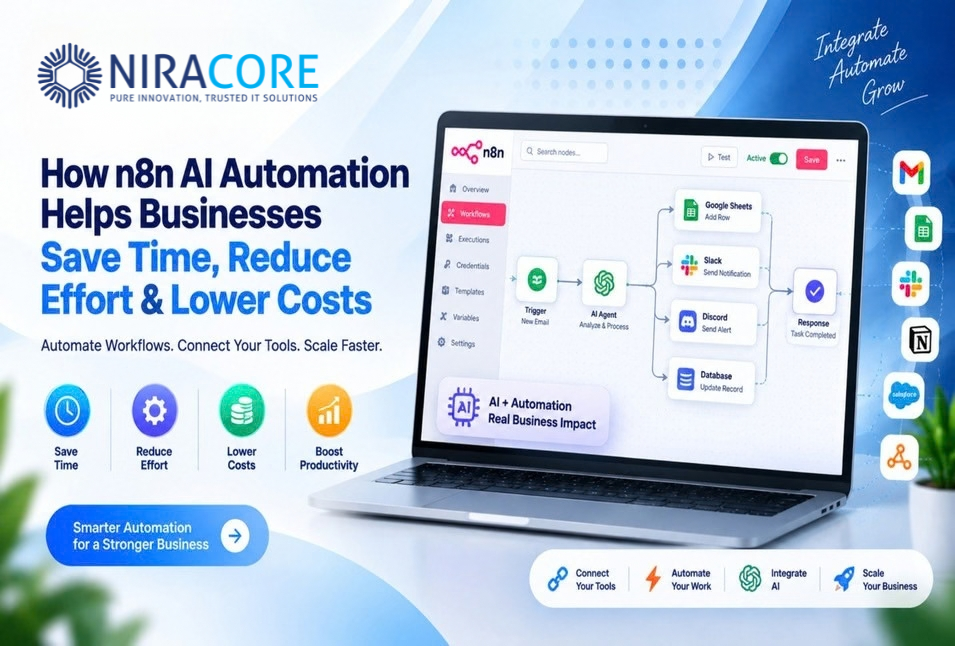
Businesses today spend a significant amount of time on repetitive tasks such as data entry, lead management, email processing, notifications, reporting, and moving information between different applications. n8n AI automation helps businesses connect their tools, automate routine workflows, and reduce the amount of manual effort required to complete everyday processes. By combining workflow automation with AI capabilities, businesses can create smarter and more efficient operations.
With n8n, organizations can connect applications, APIs, databases, CRMs, communication platforms, and AI services within customized workflows. AI can be used to analyze information, classify data, generate content, summarize documents, process customer requests, and support business decisions. This allows teams to automate repetitive processes while keeping people involved where human judgment and approval are required.
The result is a more streamlined business workflow that can save valuable time, reduce operational effort, and help control costs as the organization grows. Instead of spending hours on repetitive activities, employees can focus on customer relationships, strategy, innovation, and other high-value work. With the right workflow design, n8n AI automation can become a practical foundation for businesses looking to improve productivity and build scalable digital operations.
Why n8n AI Automation Matters for Modern Businesses
Businesses are under pressure to respond faster, control operating costs, and improve productivity while continuing to grow. Yet a surprising amount of work still depends on manual processes: reviewing emails, copying information between applications, preparing reports, updating CRM records, processing invoices, routing requests, and checking data across systems.
Each task may take only a few minutes. The problem appears when the same task is repeated hundreds or thousands of times.
n8n AI automation gives businesses a practical way to connect AI with the systems they already use and turn repetitive, multi-step processes into controlled workflows. Instead of treating AI as a standalone chatbot, organizations can use AI where interpretation is needed and automation where actions are predictable.
For business leaders, the real question is not whether AI is impressive. It is whether a process can be made faster, more reliable, easier to manage, and less expensive without creating unnecessary risk.
What Is n8n AI Automation?
n8n is a workflow automation platform that connects applications, APIs, databases, business systems, and AI services. It can be used for straightforward integrations as well as more complex workflows that combine logic, code, AI agents, approvals, monitoring, and human intervention.
Traditional automation usually follows a predictable pattern:
Trigger → Rule → Action
AI-powered automation can extend that pattern:
Trigger → Understand → Analyze → Apply business logic → Act → Escalate when necessary
For example, imagine a company receives a new customer email. A manual process might require an employee to read the message, identify the customer, open the CRM, check previous interactions, classify the request, create a ticket, and prepare a response.
An n8n AI workflow can orchestrate those steps automatically. AI can interpret the message and extract the relevant information, while deterministic workflow logic can validate fields, retrieve CRM data, route the ticket, update systems, and request human approval when required.
n8n describes its AI approach as combining AI with explicit logic, integrations, human approvals, code, monitoring, and guardrails so organizations can keep control of inputs and outcomes.
What Decision-Makers Are Experiencing
Many organizations already use AI tools, automation platforms, CRMs, analytics systems, cloud services, and collaboration tools. The challenge is that these technologies often operate in separate workflows.
A marketing team may use one platform for leads. Sales may use a CRM. Finance may use an accounting system. Customer support may use a ticketing platform. Operations may rely on spreadsheets and internal databases.
The result is a fragmented process:
Lead received → Email → Spreadsheet → CRM → Sales notification → Report
The work gets completed, but people become the integration layer.
This is where AI workflow automation can create business value. By connecting systems through an orchestration layer, organizations can reduce unnecessary handoffs and allow information to move automatically between applications.
The goal is not to automate every activity. The goal is to identify where people are spending time on repetitive work that technology can handle reliably.
The Practical View: Where n8n AI Automation Creates Business Value
A strong automation program starts with a business problem rather than a technology preference.
The most suitable processes usually share several characteristics: they are repetitive, happen frequently, involve multiple systems, have measurable processing times, depend on structured or unstructured information, or create avoidable delays and errors.
n8n can then be used to connect the moving parts. AI can interpret emails, documents, customer messages, or other unstructured inputs. Rules can control what happens next. APIs and database connections can retrieve and update information. Human approvals can be added before higher-risk actions.
This combination allows companies to move from isolated automation to connected business processes.
A useful way to think about it is:
AI handles interpretation.
Automation handles execution.
Business rules provide control.
People handle exceptions, judgment, and accountability.
Common Misconceptions About AI Automation
One common misconception is that AI automation means removing people from the process. In practice, the strongest implementations often automate repetitive steps while keeping people at important decision points.
Another misconception is that AI alone will fix a broken process. It usually will not. If data is inconsistent, responsibilities are unclear, or business rules are poorly defined, adding AI can make the process harder to manage. Workflow design, data quality, governance, and ownership remain important.
A third misconception is that a successful pilot automatically produces ROI. A workflow can run correctly and still deliver little business value if it saves only a few minutes, is rarely used, or costs more to maintain than the value it creates.
The better approach is to measure the baseline first, define success metrics, and then automate processes where the business impact is clear.
Business Opportunities and Challenges
n8n AI automation can support many areas of an organization, including sales, marketing, finance, customer service, operations, HR, IT, and reporting.
Sales teams can automate lead qualification, enrichment, routing, CRM updates, and follow-ups.
Customer service teams can classify incoming requests, retrieve customer context, draft responses, summarize conversations, and route complex cases to the right person.
Finance teams can extract invoice information, validate fields, route approvals, and update accounting systems.
Operations teams can automate notifications, exception handling, system synchronization, and recurring reports.
HR teams can process applications, extract candidate information, organize records, and trigger communication workflows.
However, automation also introduces challenges. Businesses need to consider data privacy, API limits, AI accuracy, access control, error handling, monitoring, and human oversight. A production workflow should be designed to fail safely and provide visibility when something goes wrong.
Real-World Scenarios
Scenario 1: Intelligent Lead Management
A website generates new enquiries throughout the day. Instead of manually reviewing each request, a workflow can capture the lead, validate contact information, use AI to identify intent, enrich the record, assign a priority, create or update the CRM entry, and alert the relevant salesperson.
The sales team spends less time on administration and more time on qualified opportunities.
Scenario 2: AI Assisted Customer Support
Customer messages arrive through email or chat. An AI workflow can identify intent, retrieve customer history, summarize the issue, suggest a response, and create or update the support ticket.
High-confidence, low-risk tasks can move automatically, while sensitive or ambiguous cases can be routed to an agent for approval.
Scenario 3: Automated Invoice Processing
Invoices arrive as PDFs or email attachments. A workflow can collect the document, extract the relevant fields, validate supplier details, compare information against business rules, route the invoice for approval, and update the finance system.
The result is a more consistent process with fewer manual data-entry steps.
Scenario 4: Management Reporting
Instead of asking analysts to repeatedly collect information from multiple systems, a workflow can retrieve data on a schedule, apply transformations, calculate metrics, generate a business summary, and send the results to management.
This reduces reporting effort and improves the speed at which leaders receive information.
Scenario 5: Internal Knowledge and Employee Requests
Employees often ask repetitive questions about policies, procedures, documents, and internal processes. An AI workflow can search approved knowledge sources, retrieve relevant information, generate a concise answer, and route uncertain questions to the appropriate team.
What Businesses Can Automate With n8n and AI
Lead Management: Website or form → AI qualification → CRM update → sales notification
Customer Support: Email/chat → AI classification → customer context → ticket routing → response draft
Invoice Processing: Invoice email → document extraction → validation → approval → accounting update
Marketing Operations: Content request → AI draft → review → publishing workflow → reporting
HR Operations: Application → information extraction → classification → recruitment system → recruiter alert
Data & Reporting: Data sources → processing → AI summary → report/dashboard notification
Document Processing: Document received → OCR/extraction → validation → workflow routing → archive
IT Operations: Employee request → classification → system lookup → task creation → status notification
Measuring the ROI of AI Automation
The business case for automation should be measured rather than assumed.
A simple baseline can start with:
Manual cost = Number of transactions × Time per transaction × Internal processing cost
The analysis should also consider error handling, delays, software licenses, maintenance, AI and API usage, and the amount of human review that remains after automation.
For example, if a process takes 12 minutes and occurs 600 times per month, the current manual workload is 7,200 minutes, or 120 hours per month. If a redesigned workflow reduces the manual effort substantially while preserving appropriate review points, the organization can estimate the capacity released.
But ROI is not only about labor hours. Other measures can include:
- Process completion time
- Response time
- Error rate
- Cost per transaction
- Employee productivity
- Customer satisfaction
- Revenue protection
- Number of manual handoffs
- Software costs avoided
- Volume handled without adding equivalent manual work
The most useful automation programs connect these measurements directly to business goals.
Real-World Evidence: Huel and Vodafone
Enterprise case studies show how workflow automation can create measurable operational value.
Huel reported saving more than £100,000 in software costs in its first year and close to 1,000 hours of manual work in nine months with n8n. The company also reported that its adoption expanded from five initial use cases to 75 live workflows within six months and later to nearly 200 workflows, with more than 100 employees actively using n8n.
These figures illustrate how automation can expand from individual workflows into a broader organizational capability.
Vodafone provides a different example. Its n8n deployment focused on cybersecurity workflows and orchestration. According to n8n’s case study, Vodafone launched 33 workflows from August 2024 and reported saving more than 5,000 person-days and avoiding approximately £2.2 million in costs, with continued savings reported at roughly £300,000 per month in 2025.
These are vendor-published case-study figures, not independent audits, so they are best understood as reported outcomes. Still, they demonstrate the scale of value that connected automation can create when workflows address high-volume operational processes.
Sources: Huel case study (n8n) | Vodafone case study (n8n)
Expert Recommendations
Start with process visibility rather than AI excitement. Identify where employees spend time on repetitive work, where data moves between systems, and where delays or errors have a measurable business impact.
Create a baseline before implementation. Record current processing time, volume, cost, error rate, and service levels.
Choose a small number of high-value use cases. A focused automation that saves measurable time is more useful than a large collection of experimental workflows.
Separate AI decisions from deterministic actions. Let AI interpret information when needed, but use explicit workflow rules for validation, routing, thresholds, and irreversible actions.
Add human approval where the business risk justifies it. Sensitive communications, financial actions, legal decisions, and changes to important records may require a review checkpoint.
Monitor the workflow after deployment. A production automation should have error handling, logging, access control, and clear ownership.
Finally, treat automation as an ongoing business capability. Once one process is proven, the same architecture can often be extended to adjacent processes.
How Niracore Helps Organizations Succeed
At Niracore, we approach AI automation as a business transformation opportunity rather than a standalone technology project.
We help organizations identify repetitive and high-friction processes, assess their current systems, define practical automation opportunities, and design workflows that connect AI with business applications and data.
Depending on the use case, this can include AI-powered workflow automation, AI agents, document intelligence, LLM integration, business-system integrations, analytics, reporting, and custom software.
The focus remains on measurable outcomes: less repetitive work, faster processes, better visibility, stronger consistency, and improved use of employee capacity.
A typical engagement can follow a structured path:
Discover → Analyze → Design → Build → Test → Deploy → Optimize
This approach allows organizations to begin with focused use cases and expand automation after measurable value has been demonstrated.
Future Outlook
The next stage of business automation will be defined by connected systems rather than isolated tools.
Organizations will increasingly combine workflow automation, AI agents, business rules, structured data, unstructured documents, APIs, analytics, and human approvals in the same operational processes.
That creates a different model of work.
Instead of employees spending their day moving information between systems, technology can handle the movement, classification, enrichment, summarization, and routine actions. People can then focus on decisions, relationships, exceptions, creativity, and higher-value work.
The strongest business automation programs will not be the ones with the most AI. They will be the ones that connect AI to the right business processes and measure the results consistently.
Conclusion
n8n AI automation can help organizations reduce repetitive work, connect disconnected systems, accelerate operational processes, and create more capacity without increasing manual effort at the same rate.
The value comes from combining the strengths of different technologies: AI for understanding complex information, automation for moving work forward, business rules for control, and people for judgment and accountability.
For businesses evaluating AI, the starting point does not need to be a large transformation program. It can be one process that consumes too much time, creates too many handoffs, or costs too much to operate manually.
Once that process is measured, redesigned, and automated successfully, the same principles can be extended across the organization.
The opportunity is straightforward: identify the work that should not require manual effort, then build an intelligent workflow that handles it safely and measurably.
FAQs
n8n AI automation combines workflow automation with AI models, business rules, APIs, databases, and other systems so businesses can automate multi-step processes while keeping control over how actions are executed.
It can reduce manual processing effort, shorten cycle times, lower error-related costs, reduce unnecessary software workarounds, and increase team capacity. Actual savings depend on the volume, complexity, and cost of the process being automated.
Common use cases include lead management, customer support, invoice processing, document handling, reporting, marketing operations, HR workflows, IT requests, CRM updates, and data synchronization.
The more practical model is augmentation. Automation can handle repetitive steps while employees focus on judgment, relationship management, complex cases, and strategic work.
It depends on the risk of the action. Human approval can be valuable for sensitive communications, financial transactions, legal or compliance decisions, and other high-impact actions.
Start with a high-volume, repetitive process with a measurable baseline, clear business rules, and a visible operational pain point. A small, well-defined use case is often easier to validate and scale.
Niracore helps organizations assess automation opportunities, design AI-enabled workflows, connect business systems, implement governance, and measure business outcomes across AI, data, analytics, and software initiatives.