
Businesses today have access to more data, software platforms, and automation tools than ever before. Yet many teams still spend hours handling repetitive tasks, switching between applications, investigating operational issues, and preparing reports manually.
Artificial intelligence is changing how these activities can be managed. Beyond answering questions or generating content, AI systems can now interpret information, evaluate options, use connected tools, and perform specific tasks with varying degrees of autonomy.
These systems are known as AI agents.
From automating customer support and monitoring business operations to assisting with data analysis and coordinating complex workflows, AI agents offer new ways to improve productivity and operational efficiency.
However, not every AI agent works in the same way. Some follow predefined rules, while others maintain context, evaluate possible outcomes, learn from feedback, or coordinate multiple subtasks.
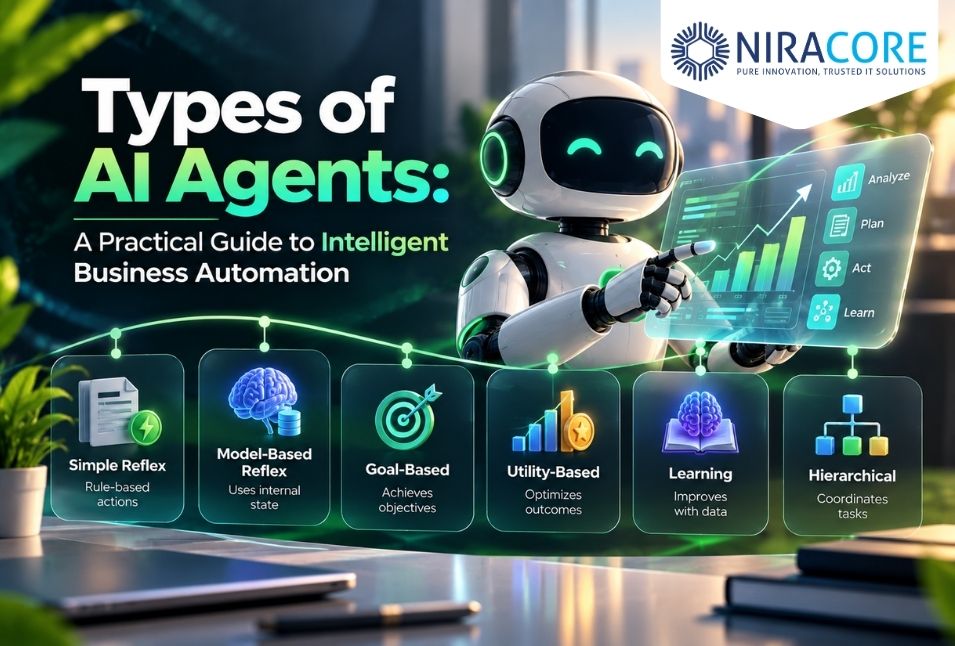
In this guide, we explore six major types of AI agents, their capabilities, business applications, advantages, limitations, and the factors organizations should consider before implementing them.
What Are AI Agents?
An AI agent is a software system that observes information from its environment, processes that information, and takes actions to achieve a defined objective.
Depending on its design, an AI agent may use predefined rules, machine learning models, large language models (LLMs), external tools, business data, or a combination of these technologies.
For example, imagine a retail company that wants to identify products running low on stock. A basic automated system might trigger an alert whenever inventory falls below a fixed threshold. A more advanced AI agent could examine sales trends, supplier lead times, seasonal demand, and existing purchase orders before recommending the next action.
The difference lies in the agent’s ability to interpret context and make decisions beyond a single predefined condition.
How Does an AI Agent Work?
Although implementations vary, most AI agents follow a common operational cycle:
1. Observe: Collect information from user requests, databases, APIs, documents, sensors, or business applications.
2. Interpret: Analyze the available information and identify the current situation.
3. Decide: Select an appropriate action based on its objective, instructions, and constraints.
4. Act: Execute a task, call a tool, update a system, or provide a recommendation.
5. Evaluate: Check the result and determine whether additional action or human intervention is required.
Not every agent performs all five stages independently. Simple rule-based agents may only match conditions and execute actions, while advanced agents may plan, use multiple tools, and evaluate intermediate results.
The right design depends on the business problem being solved.
Six Types of AI Agents Explained
AI agents are commonly classified according to how they make decisions, use information, and respond to their environment. The following six categories provide a useful foundation for understanding their capabilities.
1. Simple Reflex Agents
Simple reflex agents make decisions using predefined condition-action rules. They respond to the information available at a particular moment without maintaining a detailed history of previous situations.
Their behavior can be expressed as a straightforward principle: when a specific condition occurs, perform the corresponding action
How Do Simple Reflex Agents Work?
These agents evaluate an input against configured rules. When a condition matches, the associated action is triggered.
For example, a business might configure an agent to identify incoming customer emails containing password-reset requests and respond with the appropriate instructions.
The system does not need to understand the customer’s entire account history. It only needs to identify the relevant condition and execute the configured response.
Business Use Cases
• Automatically categorizing support tickets.
• Sending notifications when a sales target or inventory threshold is reached.
• Routing requests to the appropriate department.
• Triggering predefined workflow actions.
• Validating submitted forms against established business rules.
Advantages
• Straightforward to develop and maintain.
• Fast responses to predictable events.
• Low computational requirements.
• Consistent execution of clearly defined rules.
Limitations
Simple reflex agents struggle when information is incomplete, conditions overlap, or situations require historical context. They cannot independently handle unfamiliar scenarios unless additional rules or capabilities are introduced.
Best suited for: Repetitive processes with stable conditions and clearly defined actions.
2. Model-Based Reflex Agents
Model-based reflex agents use an internal representation of the environment to make better-informed decisions. Unlike simple reflex agents, they can maintain information about previous observations and use it to interpret the current situation.
This makes them useful when the latest input alone does not provide enough information to determine the appropriate action.
How Do Model-Based Agents Work?
A model-based agent maintains an internal state that represents relevant information about its environment. As new information becomes available, the agent updates this state and evaluates the situation using its rules and model.
Consider a customer support workflow. A basic agent might send the same response whenever it detects a delivery-related query. A model-based agent could also consider the order status, previous customer messages, shipment updates, and whether an earlier resolution attempt failed.
By considering this context, it can select a more appropriate response or escalate the case.
Business Use Cases
• Monitoring order and delivery status across connected systems.
• Tracking the progress of service requests.
• Maintaining context during multi-step workflows.
• Detecting operational issues using historical and current information.
• Supporting equipment monitoring and process control.
Advantages
• Better handling of situations that require context.
• More informed decisions than simple rule matching.
• Ability to maintain an updated view of the environment.
• Improved consistency across multi-step processes.
Limitations
The internal model must remain accurate and relevant. Missing data, outdated information, or incorrect assumptions can produce poor decisions. Designing and maintaining the model can also increase development complexity.
Best suited for: Workflows where current decisions depend on historical events, system states, or changing operational conditions.
3. Goal-Based Agents
Goal-based agents select actions according to a defined objective. Instead of merely responding to an immediate condition, they evaluate what needs to be achieved and determine a suitable sequence of actions.
This ability makes them valuable for tasks that require planning and coordination.
How Do Goal-Based Agents Work?
A goal-based agent receives an objective, evaluates the available information, considers possible actions, and selects a path toward the intended result.
For example, a sales operations team might want to identify qualified prospects from incoming leads. An AI agent could examine lead information, apply qualification criteria, gather permitted information from connected systems, and organize prospects according to their relevance.
The goal remains fixed, but the agent may choose different steps depending on the information available.
Business Use Cases
• Qualifying and prioritizing sales leads.
• Preparing research summaries from multiple approved sources.
• Coordinating onboarding activities.
• Identifying the steps needed to resolve a service request.
• Supporting data preparation and report-generation workflows.
Advantages
• Focuses actions on measurable objectives.
• Supports multi-step task execution.
• Can evaluate alternative paths toward a goal.
• Makes it easier to assess whether the intended outcome was achieved.
Limitations
A poorly defined goal can produce unsuitable actions, even when the agent follows its instructions correctly. Complex objectives may also require substantial planning, reliable integrations, and additional safeguards.
Best suited for: Tasks where the desired outcome is clear but the steps required to achieve it may vary.
4. Utility-Based Agents
Utility-based agents evaluate potential actions according to how desirable their expected outcomes are. Rather than simply asking whether an action achieves a goal, they compare alternatives using a measure of value or usefulness.
This is particularly relevant when business decisions involve competing priorities.
How Do Utility-Based Agents Work?
A utility-based agent estimates the potential outcomes of available actions and evaluates them against a defined set of preferences or performance criteria.
Imagine a logistics business deciding how to allocate delivery vehicles. The cheapest route may not always be the best choice if it creates significant delays. A utility-based approach could compare transportation costs, delivery commitments, vehicle capacity, and estimated travel time to recommend a more balanced option.
The quality of the decision depends on the accuracy of the information and the criteria used in the evaluation.
Business Use Cases
• Optimizing delivery routes and schedules.
• Allocating resources across projects.
• Prioritizing support requests according to urgency and business impact.
• Comparing suppliers using cost, reliability, and delivery performance.
• Evaluating alternative inventory replenishment strategies.
Advantages
• Helps balance multiple business objectives.
• Supports decisions involving trade-offs.
• Can evaluate alternatives consistently.
• Useful for optimization and resource allocation.
Limitations
Utility functions can be difficult to design. If the scoring criteria assign inappropriate importance to cost, speed, quality, or risk, the resulting recommendations may not reflect business priorities. More complex evaluations can also require significant computing resources.
Best suited for: Decisions involving multiple constraints, competing objectives, and measurable trade-offs.
5. Learning Agents
Learning agents improve their behavior through experience, feedback, or updated training. Rather than relying exclusively on fixed rules, they use machine learning or other adaptive techniques to identify patterns and refine their performance.
Their ability to learn makes them useful in environments where patterns and requirements change over time.
How Do Learning Agents Work?
A learning agent uses available data or feedback to improve a particular aspect of its behavior. Depending on its design, it may learn from labeled examples, performance outcomes, user feedback, or interaction with an environment.
Consider an e-commerce business that wants to improve product recommendations. A learning-based system can analyze browsing behavior, purchase history, product attributes, and other permitted signals to identify relevant products.
Its recommendations can improve as the underlying model is trained or updated using suitable data.
It is important to distinguish learning from automatic improvement during every interaction. Some agents adapt continuously, while others require a controlled retraining and evaluation process.
Business Use Cases
• Personalized product recommendations.
• Sales forecasting and demand prediction.
• Fraud and anomaly detection.
• Customer segmentation and churn prediction.
• Predictive maintenance and operational risk analysis.
Advantages
• Can identify patterns that are difficult to capture with manual rules.
• Supports adaptation as relevant data changes.
• Can improve performance when training data and feedback are reliable.
• Enables advanced predictive and personalized applications.
Limitations
Learning agents may reproduce biases present in their training data. They can also be affected by data quality problems, changing business conditions, model drift, and increased infrastructure costs.
Regular evaluation, monitoring, and appropriate governance remain essential.
Best suited for: Data-rich environments where identifying patterns or improving predictions can deliver measurable value.
6. Hierarchical Agents
Hierarchical agents organize complex activities into multiple levels of responsibility. Higher-level components manage objectives and break them into smaller tasks, while lower-level components handle specific activities.
This structure helps manage workflows that would be difficult to execute as a single operation.
How Do Hierarchical Agents Work?
A hierarchical system separates a broader objective into manageable subtasks. Depending on the architecture, a coordinating agent may assign work to specialized agents, collect their outputs, check progress, and determine what should happen next.
For example, a business intelligence workflow might involve several activities:
• A data preparation agent validates source files.
• A data analysis agent calculates business performance indicators.
• A reporting agent prepares charts and summaries.
• A coordinating agent assembles the results and checks whether the requested report is complete.
The individual components have defined responsibilities, while the overall workflow remains focused on the business objective.
These components may operate sequentially or in parallel, depending on dependencies and system design.
Business Use Cases
• Coordinating enterprise reporting workflows.
• Automating multi-stage document processing.
• Managing complex customer service operations.
• Supporting software development and testing workflows.
• Combining data extraction, validation, analysis, and reporting.
Advantages
• Breaks complex processes into manageable tasks.
• Allows specialized components to focus on specific responsibilities.
• Supports modular development and testing.
• Can improve coordination across multi-step workflows.
Limitations
Hierarchical systems introduce orchestration and communication overhead. Errors in one component can affect downstream tasks, and poorly designed dependencies can create bottlenecks. Monitoring, access control, and error handling become increasingly important as the number of components grows.
Best suited for: Complex business processes involving multiple dependent tasks, specialized capabilities, or coordinated AI agents.
Comparing the Six Types of AI Agents
| AI agent type | Decision-making approach | Example application | Complexity |
|---|---|---|---|
| Simple reflex | Predefined rules | Automated email routing | Low |
| Model-based reflex | Rules plus internal state | Context-aware support workflows | Low to medium |
| Goal-based | Actions selected to achieve an objective | Lead qualification workflow | Medium |
| Utility-based | Compares expected outcomes | Delivery and resource optimization | Medium to high |
| Learning | Improves through data or feedback | Product recommendations | Medium to high |
| Hierarchical | Coordinates tasks across levels | Automated business reporting | High |
Note: Complexity depends on the implementation, integrations, data requirements, and safeguards. These categories are conceptual and are not mutually exclusive; a production AI solution can combine several approaches.
Real-World Applications of AI Agents Across Industries
The practical value of AI agents becomes clearer when they are connected to specific business challenges.
1. Retail and E-Commerce
Retail businesses handle large volumes of transactions, inventory changes, customer requests, and supplier information.
AI agents can help monitor stock levels, identify unusual sales patterns, categorize customer inquiries, and support replenishment decisions. More advanced systems can combine historical sales, seasonal demand, and supplier lead times to generate recommendations for inventory teams.
2. Healthcare
Healthcare organizations manage appointments, administrative documentation, patient inquiries, and operational information.
With suitable privacy controls and human oversight, AI agents can assist with appointment coordination, document classification, administrative workflows, and information retrieval. Clinical decisions and sensitive actions require appropriate professional supervision and validation.
3. Finance and Accounting
Finance teams frequently process invoices, reconcile records, review transactions, and prepare reports.
AI agents can support invoice extraction, exception identification, document matching, and financial reporting workflows. Actions involving payments, approvals, or regulatory obligations should remain subject to explicit authorization and audit controls.
4. Sales and Customer Support
Sales and service teams often spend considerable time updating CRM records, categorizing inquiries, researching prospects, and following up on requests.
AI agents can summarize conversations, identify missing information, suggest responses, route requests, and prepare follow-up activities. When integrated with approved business systems, they can also assist with routine record updates.
5. Business Intelligence and Data Analytics
Organizations may have valuable information distributed across databases, spreadsheets, cloud platforms, and business applications.
AI agents can assist with data quality checks, explain performance changes, identify unusual trends, and generate initial report summaries. When combined with reliable analytics platforms, they can help teams move from manually gathering information toward faster, more informed decision-making.
For example, a business could use an AI-assisted reporting workflow to detect a decline in regional sales, identify the affected product categories, and prepare a summary for management review.
The system should clearly distinguish observed facts from potential explanations and validate its findings against trusted data sources.
AI Agents vs. Traditional Automation: What Is the Difference?
Traditional automation and AI agents both help reduce manual work, but they solve problems in different ways.
Traditional automation typically follows predefined workflows and conditions. AI agents may interpret less structured information, select tools, and determine which steps are appropriate within an assigned objective.
| Capability | Traditional automation | AI agents |
|---|---|---|
| Workflow execution | Follows configured steps | May select steps based on context |
| Input handling | Often structured and predictable | Can support structured and unstructured inputs |
| Decision-making | Predetermined rules and logic | Rules, models, goals, or evaluated alternatives |
| Adaptability | Requires workflow or rule changes | Depends on the agent’s model and design |
| Best use case | Repetitive, stable processes | Context-dependent or multi-step tasks |
| Governance | Workflow and access controls | Workflow controls plus AI-specific evaluation and monitoring |
Neither approach is universally better.
For predictable, high-volume transactions, conventional automation may be simpler, cheaper, and more reliable. AI agents are worth considering when the task requires interpretation, variable steps, or decisions based on changing context.
In many organizations, the strongest solution combines both: traditional automation handles deterministic operations, while AI components address tasks that require more flexible reasoning.
How to Choose the Right AI Agent for Your Business
Selecting an AI agent should begin with a business requirement, not with the most advanced technology available.
Step 1: Identify a Specific Business Problem
Choose a process with a clear operational challenge, such as lengthy report preparation, repetitive support requests, inconsistent document processing, or time-consuming data validation.
Step 2: Assess the Decision Complexity
Determine whether the process requires simple rule matching, historical context, goal-oriented planning, optimization, learning, or coordination across multiple tasks.
A simple process does not need a complex agent architecture.
Step 3: Evaluate Data Availability
Identify the databases, APIs, documents, and business applications the agent needs to access. Assess data quality, permissions, freshness, and integration requirements before development begins.
Step 4: Define Permissions and Human Oversight
Establish which actions an agent can perform independently and which require approval. Begin with limited permissions, particularly when the workflow involves customer communications, financial transactions, sensitive information, or changes to critical business systems.
Step 5: Establish Measurable Success Criteria
Define how the solution will be evaluated. Useful metrics may include processing time, error rate, task completion rate, cost per transaction, escalation frequency, and user satisfaction.
Step 6: Start Small and Scale Gradually
Build a proof of concept around a focused use case. Test the system with realistic scenarios, monitor failures, validate the results, and expand its responsibilities only when performance meets the agreed requirements.
This incremental approach helps organizations control implementation costs and identify limitations before the solution becomes part of a critical business workflow.
Challenges to Consider Before Implementing AI Agents
AI agents can create meaningful efficiencies, but they also introduce technical and operational considerations.
Data quality and access: An agent cannot reliably produce business insights from inaccurate, incomplete, or outdated information.
Incorrect outputs: AI systems may misinterpret requests, generate unsupported conclusions, or select unsuitable actions. Validation and clear fallback procedures are essential.
Security and permissions: Connected agents should receive only the access necessary to perform their assigned tasks. Sensitive operations require appropriate approval mechanisms.
Integration complexity: Connecting agents to existing enterprise applications, APIs, and databases may require substantial engineering and testing.
Performance and cost: Model usage, infrastructure, tool calls, and ongoing monitoring can affect the total cost of ownership.
Governance and accountability: Organizations need clear ownership, audit trails, performance monitoring, and procedures for escalating issues to human operators.
Addressing these considerations early makes AI adoption more predictable and helps businesses build solutions that are dependable in real operating environments.
How Niracore Can Help You Explore AI-Powered Business Automation
At Niracore, we focus on helping businesses turn technology into practical operational improvements through AI, business intelligence, data engineering, and custom software solutions.
Implementing AI agents successfully requires more than selecting a model. It involves understanding business workflows, connecting reliable data sources, integrating enterprise applications, defining decision boundaries, and measuring outcomes.
Our technology capabilities can support organizations exploring:
• AI-powered workflow automation: Reduce repetitive operational work and streamline multi-step processes.
• Business intelligence and analytics: Build data pipelines, dashboards, and reporting solutions that improve business visibility.
• Data engineering and cloud integration: Connect business systems and establish dependable data foundations for AI-enabled applications.
• Custom software development: Integrate intelligent capabilities into applications and workflows aligned with business requirements.
• Reporting and decision support: Help teams identify trends, investigate performance changes, and access actionable information more efficiently.
The right starting point is often a focused proof of concept that addresses one measurable business challenge. From there, the solution can be evaluated, refined, and expanded based on actual results.
If your organization is exploring AI agents or intelligent automation, Niracore can help you assess the opportunity and identify a practical implementation approach.
Conclusion
AI agents represent an important development in business automation, but their value depends on how well their capabilities match the problem being solved.
Simple reflex agents are effective for predictable, rule-driven tasks. Model-based agents add contextual awareness, goal-based agents focus on outcomes, and utility-based agents evaluate competing priorities. Learning agents use data and feedback to improve specific capabilities, while hierarchical agents coordinate complex workflows through specialized components.
The most effective approach is not necessarily to build the most autonomous system. It is to choose an appropriate architecture, connect reliable data, establish clear boundaries, and demonstrate measurable business value.
By starting with well-defined use cases and expanding gradually, organizations can explore AI-powered automation while maintaining control, accountability, and operational reliability.
Ready to explore AI-powered business automation? Contact Niracore to discuss your requirements and identify opportunities to improve your workflows with AI, analytics, and custom software solutions.