
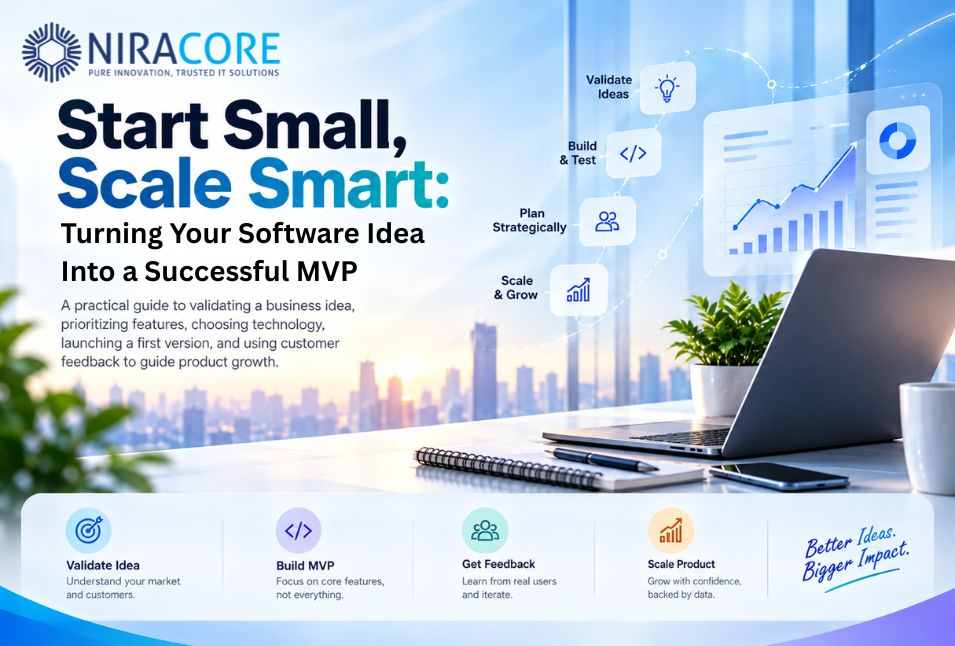
Turning a business idea into a successful software product requires more than good planning and technical expertise. It requires a clear understanding of your customers, the problem you want to solve, and whether people are willing to use or pay for your solution.
Many startups and established businesses make the mistake of investing heavily in product development before validating their ideas. They spend months building multiple features, designing complex workflows, and integrating advanced technologies, only to discover that their target audience needs something different.
This is where a Minimum Viable Product (MVP) becomes valuable.
An MVP allows businesses to introduce a simplified but functional version of a product with the essential features needed to solve a specific problem. Instead of waiting until the entire product is complete, businesses can test their assumptions with real users, gather feedback, and make informed decisions about future development.
Whether you are planning a SaaS platform, a mobile application, an AI-powered business tool, or an enterprise software solution, a well-planned MVP can help you reduce uncertainty and use development resources more effectively.
In this guide, we will explore how to build an MVP, from validating your initial idea to launching the product and planning its next phase of growth.
What Is a Minimum Viable Product (MVP)?
A Minimum Viable Product is an early version of a software product that includes the essential functionality required to deliver value to its intended users and test important business assumptions.
The objective is not to build an incomplete or low-quality application. It is to develop a focused solution that addresses a genuine customer problem without investing prematurely in features that may not be necessary.
For example, imagine a business wants to develop a cloud-based inventory management platform for small retailers. The long-term product might include supplier management, demand forecasting, automated purchasing, accounting integrations, and advanced analytics.
However, the first version may only need product management, stock tracking, low-inventory notifications, and a basic reporting dashboard.
These capabilities could be sufficient to determine whether retailers find the solution useful and whether it improves their inventory management processes.
A successful MVP should help answer three fundamental questions:
• Is the problem worth solving? Does the target audience experience a genuine challenge?
• Does the proposed solution deliver value? Can users accomplish their intended tasks effectively?
• Is there a viable business opportunity?
Is there evidence of demand, willingness to pay, or another sustainable path to adoption? The answers help determine whether to improve the existing product, expand its functionality, revise the concept, or reconsider the original approach.
Why Should Businesses Build an MVP Before Developing a Complete Product?
MVP development is useful because it creates opportunities to learn before committing substantial time and money to a complete solution.
1. Validate Your Business Idea Early
Market research and internal discussions can help establish an initial direction, but actual user behaviour provides stronger evidence. An MVP allows you to observe how potential customers interact with your solution. Their feedback can reveal whether your product addresses the right problem and whether its features are practical.
2. Control Initial Development Costs
Building every feature at once can increase development effort, testing requirements, and infrastructure expenses. By focusing on essential functionality, businesses can manage their initial investment and allocate resources to the capabilities that matter most.
3. Reach the Market Faster
A smaller, well-defined scope can help teams deliver a working product sooner than a full-scale implementation. Early access to real users also allows businesses to begin learning from actual usage instead of relying entirely on assumptions.
4. Reduce Product Development Risks
An MVP helps identify potential issues with usability, technical feasibility, customer demand, and business processes before the product becomes more complex. Although it cannot eliminate every risk, it gives decision-makers better evidence for planning subsequent investments.
5. Establish a Foundation for Future Growth
When the initial product is designed with a suitable architecture, it can evolve as user requirements become clearer. The key is to avoid unnecessary complexity while making sensible decisions about security, maintainability, integrations, and future expansion.
How to Build an MVP: A Step-by-Step Process
Developing a useful MVP requires a structured approach that connects business objectives with technical implementation. The following steps provide a practical framework for moving from an initial idea to a market-ready first version.
Step 1: Identify the Problem and Define Your Target Audience
Before selecting technologies or designing screens, determine the problem your product is intended to solve. A product idea may sound promising internally, but it needs a clear use case and a defined audience.
Start by asking:
• Who experiences the problem?
• How frequently does it occur?
• What solutions do people currently use?
• What limitations do existing solutions have?
• What measurable improvement would your product provide?
For example, a distribution company may rely on spreadsheets and manual communication to track field sales activities. Managers may struggle to monitor sales representatives, identify missed visits, and review outlet-level performance.
An MVP for this business could focus on recording field visits, capturing orders, and providing managers with a simple activity dashboard. This creates a clear connection between the business problem and the proposed software.
Practical tip: Speak with potential users, review existing workflows, and document recurring challenges before finalizing your requirements. The objective is to validate the problem rather than convince people that your idea is correct.
Step 2: Research the Market and Evaluate Existing Solutions
Once you understand the problem, investigate how the market currently addresses it. Competitor research can reveal useful features, common pricing approaches, customer expectations, and opportunities to differentiate your product.
Evaluate competing solutions based on:
• Core functionality and ease of use
• Target customer segments
• Pricing and subscription models
• Integration capabilities
• Customer feedback and recurring complaints
• Gaps that your product could address
You do not need to create a product that includes everything your competitors offer. In many cases, a more focused solution for a specific industry or workflow can be a stronger starting point.
For example, instead of developing another general-purpose project management application, you might build a lightweight workflow platform specifically for engineering service companies that need project tracking, timesheets, and client reporting in one place.
The findings from this stage should help clarify your product’s value proposition and the initial audience you want to serve.
Step 3: Define the MVP Scope and Prioritize Features
Feature prioritization is one of the most important decisions in MVP development. Stakeholders often have different expectations. Business teams may request detailed reports, users may want additional convenience features, and technical teams may recommend infrastructure improvements.
Without a clear prioritization process, the scope can expand until the MVP becomes almost as complex as the complete product.
Must-have features: Essential capabilities required to solve the primary problem.
Should-have features: Useful enhancements that improve the experience but are not necessary for initial validation.
Future features: Advanced functionality that can be considered after the MVP has been tested.
Consider a proposed appointment management platform:
| Feature | MVP Priority | Reason |
|---|---|---|
| User registration and login | Must-have | Enables secure user access |
| Appointment booking | Must-have | Delivers the primary value |
| Booking confirmation | Must-have | Communicates booking status |
| Basic appointment dashboard | Must-have | Helps users manage bookings |
| Advanced analytics | Future | Requires meaningful usage data |
| AI-based recommendations | Future | Can be evaluated after validating core demand |
| Multiple third-party integrations | Should-have or future | Depends on initial user requirements |
The correct priorities depend on your business model and target audience. Security, privacy, and essential reliability requirements should not be removed simply to reduce the initial scope.
Practical tip: Every proposed MVP feature should have a clear purpose. If it does not support the primary user journey or test an important business assumption, consider postponing it.
Step 4: Map the User Journey and Design a Prototype
Once the core features have been identified, the next step is to define how users will interact with the product. A user journey outlines the sequence of actions users take to complete a specific task. Mapping this journey helps identify unnecessary steps, missing functionality, and potential usability issues before development begins.
For example, a user journey for a service-booking application might include the following steps:
- The user creates an account or signs in.
- The user selects a service.
- The user chooses an available time slot.
- The user confirms the booking.
- The application displays the booking details.
Once the user journey is defined, translate the workflow into wireframes or an interactive prototype. Wireframes establish the layout and structure of individual screens, while interactive prototypes demonstrate how users navigate between screens and interact with key features without requiring a fully developed application.
During this phase, validate the proposed design with representative users and incorporate their feedback. Testing early helps uncover usability problems, refine workflows, and reduce the risk of costly design changes later in the development process.
A well-defined user journey and validated prototype provide a clear foundation for development, helping ensure that the MVP focuses on essential functionality and delivers a smooth, intuitive user experience.
Step 5: Choose the Right Technology Stack
Your technology decisions should reflect the product’s requirements, available budget, development capabilities, and long-term business objectives. There is no universally correct technology stack for every MVP. A suitable solution should support the required functionality without introducing unnecessary technical overhead.
Depending on the use case, your technology stack might include:
• Frontend development: React, Angular, or another suitable web framework.
• Backend development: .NET, Node.js, Python, or an appropriate alternative.
• Database: PostgreSQL, SQL Server, or another database suited to the data model.
• Cloud infrastructure: Microsoft Azure, AWS, or Google Cloud.
• Analytics and reporting: Power BI or embedded analytics when business reporting is part of the product.
• AI capabilities: Appropriate AI models and supporting services when intelligent automation is central to the use case.
For example, a B2B SaaS product with complex business rules may benefit from a structured backend architecture, a reliable relational database, and cloud infrastructure that supports controlled deployment and monitoring.
An AI-powered application may require additional planning around model selection, data quality, inference costs, response times, and evaluation.
Avoid choosing technologies solely because they are popular. Select tools that support your immediate requirements and provide a reasonable path for future development.
Practical tip: Keep the architecture simple, but do not ignore essential security controls, maintainability, automated testing, or data protection.
Step 6: Develop the MVP in Manageable Iterations
With the scope, design, and technical foundation established, development can begin. An iterative approach allows teams to deliver functionality in smaller increments, review progress regularly, and incorporate feedback before the product becomes difficult to change.
A typical development cycle includes:
• Sprint planning: Identify the features and tasks to be completed.
• Implementation: Develop the frontend, backend, database components, and integrations required for the selected functionality.
• Testing: Validate business logic, user interactions, data handling, and application behaviour.
• Review: Demonstrate working functionality to stakeholders and collect feedback.
• Refinement: Resolve issues, adjust priorities, and plan the next increment.
For instance, the first iteration might establish authentication and the application’s basic structure. The next could deliver the primary business workflow, followed by reporting, notifications, and other essential capabilities. The exact sequence depends on dependencies and product complexity.
During development, maintain clear communication between business stakeholders, designers, developers, and testers. Frequent demonstrations help ensure that the team is building the intended solution rather than simply completing a list of technical tasks.
Step 7: Test Quality, Security, and Usability Before Launch
A minimum viable product still needs to be reliable enough for real users. Reducing the feature scope should not mean ignoring testing or accepting avoidable quality problems. An unstable MVP can generate misleading feedback because users may reject the implementation rather than the underlying idea.
Before release, evaluate the following areas:
• Functional testing: Do the core features work according to requirements?
• Usability testing: Can users complete important tasks without unnecessary difficulty?
• Performance testing: Does the application respond appropriately under expected workloads?
• Security testing: Are authentication, authorization, sensitive data, and common vulnerabilities addressed?
• Compatibility testing: Does the product work across its intended devices and environments?
• Data validation: Are records stored, processed, and displayed correctly?
• Recovery and monitoring: Can the team identify failures and respond to operational issues?
The level of testing should be appropriate to the product’s risk profile. Applications handling financial transactions, personal information, or business-critical processes may require additional controls before release.
A defined acceptance checklist helps ensure that the MVP is ready for its intended audience.
Step 8: Launch to a Defined Group of Early Users
Instead of immediately targeting the entire market, consider releasing the MVP to a controlled group of early adopters. These users should represent the audience you expect to serve. Their experience can provide useful evidence about the product’s value, usability, and practical limitations.
Depending on your business model, an initial launch could involve:
• A pilot with selected business customers
• A private beta for invited users
• A limited public release
• A proof-of-concept deployment within one department
• A trial version for a specific customer segment
Before launching, prepare onboarding instructions, support channels, basic product documentation, and an approach for reporting issues.
You should also define what you want to learn from the launch. For example, a pilot may aim to determine whether users can complete a workflow independently, whether the product saves time, or whether businesses are willing to pay for the service.
A focused launch makes it easier to collect meaningful feedback and respond quickly when adjustments are needed.
Step 9: Measure Results and Improve the Product
An MVP launch is the beginning of the learning process, not the end of product development. After launch, analyse how users interact with the product and compare the results with your original objectives.
Useful MVP performance indicators may include:
• User activation and onboarding completion
• Adoption of core features
• Task completion and abandonment rates
• Weekly or monthly active users
• User retention over time
• Customer satisfaction and qualitative feedback
• Conversion from trial to paid usage
• Customer acquisition cost, where relevant
• Time saved or operational improvements for business customers
Not every metric will be relevant to every product. Select a small set of indicators that directly relate to the business hypothesis being tested.
For example, if your MVP is designed to automate invoice processing, the most useful measures may include processing time, extraction accuracy, manual correction rates, and the number of invoices successfully handled.
Use these findings to determine the next steps. If users find the core workflow valuable, improve it and expand carefully. If users struggle with the experience, investigate the reasons before adding more features. If demand is weak, revisit the problem, target audience, or value proposition.
This feedback-driven approach helps businesses make product decisions based on evidence rather than assumptions.
Common MVP Development Mistakes to Avoid
Even a promising product idea can encounter difficulties when the MVP is poorly scoped or managed.
Building Too Many Features
A long feature list can delay launch and make it harder to identify which capabilities actually create value.
What to do instead: Prioritize one primary user journey and expand the product as evidence supports new requirements.
Skipping Customer Validation
Building entirely from internal assumptions increases the risk of developing a solution that does not address the market’s real needs.
What to do instead: Interview potential customers, review existing workflows, and test early concepts before committing to extensive development.
Confusing an MVP With a Low-Quality Product
A product with missing essential workflows, poor usability, or unreliable performance may fail to provide meaningful feedback.
What to do instead: Reduce the scope, not the standards required for a functional and trustworthy user experience.
Choosing Technology Without Considering Business Needs
A complicated architecture or unsuitable framework can increase costs and slow down development.
What to do instead: Evaluate technical choices against functional requirements, delivery timelines, team capabilities, security, and future scalability.
Ignoring Post-Launch Feedback
Launching a product without collecting usage data or speaking with customers limits the value of the MVP approach.
What to do instead: Establish feedback channels and success metrics before launch, then use the results to guide subsequent development.
Failing to Plan for Product Evolution
Although an MVP should remain focused, decisions about data structures, access controls, integrations, and deployment can affect future development costs.
What to do instead: Build a practical foundation that supports expected growth without overengineering the first release.
How Much Does MVP Development Cost?
The cost of MVP development depends on the product’s complexity, feature scope, technology choices, integration requirements, and the experience of the team delivering it.
A simple web application with a limited workflow may require considerably less effort than a multi-tenant SaaS platform with role-based access, payment processing, external integrations, and advanced reporting.
Several factors influence the overall investment:
• Product complexity: More workflows, user roles, and business rules generally increase development effort.
• UI/UX requirements: Custom interface design, accessibility needs, and complex user interactions affect design and implementation time.
• Technology and infrastructure: Cloud services, third-party APIs, licensing, hosting, and AI usage may contribute to ongoing expenses.
• Data and integration requirements: Connecting existing business systems or migrating historical data can add complexity.
• Testing and security: The testing strategy and risk profile of the application influence the effort required before launch.
• Team composition: The mix of product management, design, development, testing, and DevOps resources affects delivery cost.
Rather than relying on a generic price estimate, businesses should first define the MVP requirements and request an estimate based on the proposed scope.
A practical estimate should distinguish essential launch functionality from optional enhancements and identify assumptions, dependencies, and potential risks. This makes it easier to compare development approaches and avoid unexpected costs caused by unclear requirements.
How Long Does It Take to Build an MVP?
There is no fixed timeline for every MVP. A focused application may be delivered relatively quickly, while a product involving complex integrations, AI functionality, or strict compliance requirements may take longer.
The timeline typically depends on:
• The clarity and stability of the requirements
• The number of essential user journeys
• Design and prototyping needs
• Technical complexity and integration dependencies
• Team availability and decision-making speed
• Testing, security, and deployment requirements
A useful planning approach is to divide delivery into discovery, design, development, testing, and launch preparation. Each phase should produce a clear outcome. For example, discovery establishes the product scope, design validates the user journey, development delivers working features, and testing confirms readiness for the intended release.
Avoid committing to an arbitrary launch date before the requirements and dependencies have been reviewed. The objective is to deliver the smallest useful product within a realistic timeframe while maintaining appropriate quality standards.
When Should You Scale Beyond the MVP?
An MVP should evolve when real-world evidence indicates that further investment is justified. You may be ready to move beyond the initial release when:
• Users consistently engage with the core functionality.
• Customers report measurable value from the product.
• There is credible evidence of willingness to pay or sustained adoption.
• Important usability and reliability issues have been addressed.
• New feature requests reveal recurring customer needs.
• The technical foundation can support the next stage of development.
Scaling does not necessarily mean adding more features immediately. It may involve improving performance, strengthening security, automating operational tasks, expanding integrations, or refining the customer onboarding process.
For a SaaS platform, the next phase might include subscription management, additional user roles, advanced analytics, or improved tenant administration. For an AI-powered solution, it might involve evaluating output quality, improving data pipelines, or introducing monitoring and human review.
The right next step depends on what the MVP has demonstrated and which improvements will create the greatest business value.
How Niracore Can Help You Build Your MVP
Turning an initial concept into a working software product requires the right combination of business understanding, technical planning, and disciplined execution.
At Niracore, we support businesses looking to translate their ideas into practical digital solutions through custom software development, SaaS product development, data engineering, analytics, cloud integration, and AI-driven automation. Depending on your requirements, our support can include:
MVP Planning and Technical Consulting
Define the initial product scope, assess technical feasibility, and establish a development roadmap aligned with your business objectives.
Custom Software Development
Build web applications, business platforms, and tailored software solutions around your essential user workflows.
SaaS Product Development
Develop cloud-based applications with appropriate attention to maintainability, access management, integrations, and future product expansion.
AI and Automation
Explore suitable opportunities to incorporate intelligent features and automate repetitive business processes where they deliver measurable value.
Data and Analytics Integration
Connect relevant data sources and introduce reporting capabilities that help businesses monitor operations and evaluate outcomes.
Continuous Improvement
Refine the product based on user feedback, changing requirements, and performance observations.
Our approach focuses on understanding the business problem first, identifying the functionality required for the initial release, and selecting a practical implementation strategy.
Whether you are a startup validating a new idea or an established organization exploring a new digital product, a structured MVP approach can help you make more informed development decisions.
Final Thoughts
Building a Minimum Viable Product is not simply about releasing software with fewer features. It is about testing a business idea through a focused, functional solution and learning from the people who use it.
The most effective MVP development process begins with a clearly defined problem, validates the market opportunity, prioritizes essential features, and follows a disciplined path through design, development, testing, and launch.
After release, real-world feedback and meaningful performance indicators should guide the product’s evolution.
By resisting unnecessary complexity and focusing on measurable value, businesses can make better use of development resources while building a stronger foundation for future growth.
Turn Your Software Idea Into a Working MVP With Niracore
Building a successful Minimum Viable Product starts with identifying the right problem, validating the business opportunity, and prioritizing the features that deliver meaningful value.
Niracore helps startups and established businesses translate software ideas into practical digital products. Our capabilities include MVP planning, custom software development, SaaS product engineering, cloud integration, AI-powered automation, and data analytics.
Whether you are validating a new SaaS concept, developing a business application, or exploring an AI-powered solution, we can help you define a realistic scope and plan the next steps toward implementation.
What can you discuss with our team?
- Your product idea and target audience
- Essential features for the first release
- Technology options and integration requirements
- Estimated development effort and delivery milestones
- A roadmap for testing, feedback, and future improvements
You do not need a complete specification to start the conversation. A clear business problem and an initial idea are enough to begin exploring the right approach.
Ready to discuss your MVP?
Contact Niracore to discuss your product idea and explore a practical development roadmap.