
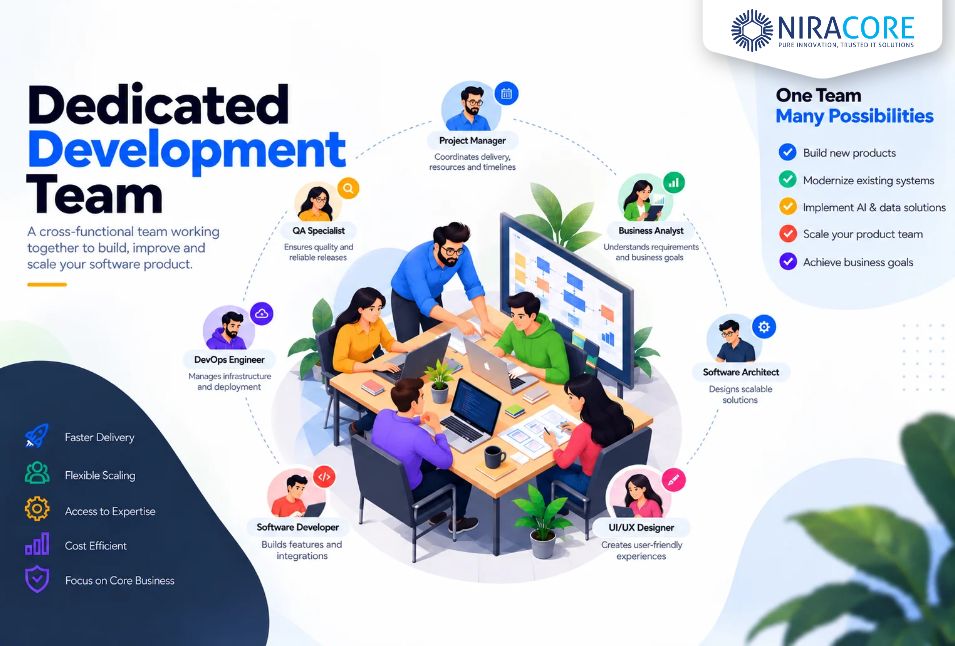
Looking to scale your software development without the cost and complexity of hiring an in-house team? A dedicated development team can help you access skilled professionals, speed up product development, and adapt to changing business needs.
Startups can use this model to launch a minimum viable product (MVP). Established businesses can use it to modernize legacy applications or expand their engineering capacity.
However, choosing the right team involves more than hiring developers. You need professionals who understand your business goals, communicate clearly, and maintain software quality.
In this guide, we explain how dedicated development teams work, their benefits, typical costs, and the steps to choosing the right technology partner.
What Is a Dedicated Development Team?
A dedicated development team is a group of technology professionals assigned to work on a client’s software product or ongoing technology initiatives for an agreed period.
Depending on the engagement, the team may include software developers, technical architects, quality assurance engineers, UI/UX designers, DevOps specialists, business analysts, and project managers.
Unlike hiring individual freelancers for isolated tasks, this approach establishes a consistent team that becomes familiar with your product, business processes, technical environment, and development priorities.
Your business typically retains control over product strategy, business requirements, and priorities, while the technology partner supports recruitment, resource management, and the agreed delivery responsibilities.
Example: How a Dedicated Development Team Works
Instead of recruiting every specialist individually, the company engages a dedicated development team. The collaboration might work as follows:
• The product owner defines business goals and feature priorities.
• The technical lead establishes the architecture and development standards.
• Developers build and integrate application features.
• QA engineers validate functionality and identify defects.
• DevOps engineers support deployment automation and infrastructure.
• The project manager coordinates delivery, dependencies, and reporting.
The team works against an agreed roadmap, shares regular progress updates, and adjusts priorities as the product evolves.
The key idea: A dedicated development team provides sustained engineering capacity rather than a one-time delivery of software.
Why Are Businesses Choosing Dedicated Development Teams?
Software requirements rarely remain static. A startup may need to validate its product before investing heavily, while an established company may need additional engineering capacity to support new features, integrations, or digital transformation.
A dedicated team offers a flexible way to address these needs without requiring every specialist to become a permanent employee.
1. Faster Access to Specialized Technology Skills
Recruiting experienced developers can take considerable time, particularly when a project requires expertise in niche technologies or multiple technical disciplines. A dedicated development partner can help businesses access relevant skills across areas such as:
- Custom software and SaaS development
- Web and mobile application development
- AI and machine learning solutions
- Cloud engineering and DevOps
- Data engineering and analytics
- API development and system integration
- Software testing and quality assurance
This can be especially valuable when your internal team lacks a specific capability needed to move a project forward.
2. Flexible Team Scaling
Your development requirements may change throughout the product lifecycle. During an MVP launch, you might need a small team focused on core features. As the product gains users, you may need additional backend engineers, QA specialists, cloud engineers, or security expertise.
A dedicated model allows you to plan resource changes around your roadmap and budget. Rather than permanently hiring every specialist, you can discuss team composition and capacity with your technology partner as priorities change.
Keep in mind that scaling depends on resource availability, contract terms, onboarding requirements, and the complexity of the work.
3. Better Continuity and Product Knowledge
Frequent changes in development personnel can create knowledge gaps, inconsistent implementation, and repeated onboarding effort. A stable development team has more opportunities to build an understanding of your architecture, business rules, integrations, and customer expectations.
Over time, this context can improve technical decision-making and reduce the effort required to explain requirements repeatedly. For long-running SaaS platforms and enterprise applications, continuity is often just as important as coding speed.
4. More Predictable Development Planning
A dedicated team can work within an agreed delivery framework that includes sprint planning, milestone reviews, technical documentation, and regular progress reporting.
This gives business stakeholders better visibility into work completed during each sprint, features currently under development, outstanding defects and technical risks, upcoming releases and dependencies, and resource utilization and planned capacity.
Predictability does not mean every deadline is guaranteed. It means risks, changes, and progress are managed through a transparent process rather than discovered at the last minute.
5. Potential Cost Advantages
Building an in-house engineering team involves more than salaries. Businesses must also account for recruitment, onboarding, employee benefits, equipment, training, management, and retention.
A dedicated development arrangement can reduce some of this administrative burden by consolidating engineering resources under a service agreement. However, outsourcing is not automatically cheaper in every situation. Total costs depend on team seniority, geography, engagement duration, management responsibilities, and the level of technical expertise required.
The best comparison considers the total cost of achieving the desired outcome, not just the hourly rate.
6. Greater Focus on Core Business Priorities
Technology leaders and founders often spend substantial time coordinating recruitment, resolving delivery issues, and managing technical dependencies. A well-structured development partnership can help reduce this operational load.
Your internal leadership can focus more on product strategy, customer relationships, market expansion, and business performance while the engineering team concentrates on implementation. This benefit is strongest when responsibilities are clearly defined and the external team has the technical leadership needed to work effectively.
What Does a Dedicated Development Team Look Like?
There is no single team structure suitable for every project. The right composition depends on your product, technology stack, delivery timeline, and budget.
A typical dedicated software development team may include the following roles.
Project Manager or Delivery Manager
Coordinates schedules, resources, communication, risks, and delivery commitments. This role is particularly useful when the engagement involves several specialists or multiple workstreams.
Technical Lead or Software Architect
Defines technical direction, reviews architectural decisions, establishes engineering standards, and helps ensure the application remains maintainable and scalable.
Frontend Developers
Build the interfaces users interact with, including web applications, dashboards, portals, and responsive user experiences.
Backend Developers
Implement application logic, APIs, databases, authentication, integrations, and other server-side components.
QA Engineers
Validate requirements, test workflows, identify defects, and support regression testing before releases.
DevOps and Cloud Engineers
Help manage cloud infrastructure, deployment pipelines, monitoring, environment configuration, and release automation.
UI/UX Designers and Business Analysts
Depending on project needs, these specialists improve usability, clarify requirements, map business processes, and translate stakeholder expectations into actionable specifications.
Not every engagement needs all these roles full-time. A smaller product might need two developers and part-time QA support, while an enterprise platform may require a larger cross-functional team.
Practical recommendation: Start with the smallest team that can deliver the initial roadmap reliably. Add specialist roles when the project requirements justify them.
Dedicated Development Team vs. In-House Team vs. Staff Augmentation vs. Project Outsourcing
| Factor | Dedicated team | In-house team | Staff augmentation | Project outsourcing |
|---|---|---|---|---|
| Recruitment | Partner-supported | Managed internally | Partner-supported | Managed by vendor |
| Team continuity | Designed for ongoing work | Typically ongoing | Depends on contract | Depends on project |
| Daily management | Shared / agreed | Internal | Primarily internal | Primarily vendor-led |
| Scope flexibility | High | High | High | Depends on contract |
| Best suited for | Long-term product development | Core permanent capabilities | Filling specific skill gaps | Clearly defined deliverables |
| Typical pricing | Recurring team fee | Salary + operating costs | Rate per resource | Fixed price or milestones |
Dedicated Development Team
A coordinated group of specialists works on your product or ongoing roadmap. This model suits businesses that need sustained engineering capacity, multiple complementary skills, and continuity as requirements evolve. Management responsibilities should be clearly agreed with the provider.
In-House Development Team
Employees are recruited and managed directly by your organization. This model is often suitable when software engineering is a core, permanent business capability and you want direct control over hiring, culture, priorities, and long-term technical knowledge. It also requires ongoing investment in recruitment, retention, and team operations.
Staff Augmentation
External specialists join your existing team to fill specific skill or capacity gaps, while your organization typically retains day-to-day management. This option works well when you already have strong technical leadership and need extra developers or specialists for a defined period.
Project Outsourcing
A vendor is engaged to deliver a defined project, component, or set of milestones. This can suit work with clear requirements and acceptance criteria, such as building a customer portal or implementing a discrete integration. Scope changes and handover terms should be agreed in advance.
When Should You Choose a Dedicated Development Team?
Consider this model when you have a continuing software roadmap rather than a single deliverable; your internal team needs additional engineering capacity; product requirements are likely to evolve; you need multiple complementary technical skills; or you want consistent developers who can build long-term product knowledge.
When Is Staff Augmentation Better?
Staff augmentation may be more suitable when you already have strong technical leadership and project management but need one or two additional specialists. For example, your team might need an experienced .NET developer or Azure Data Engineer for a specific period.
When Does Project Outsourcing Make More Sense?
Project outsourcing may be preferable when requirements are well defined, acceptance criteria are clear, and you want a vendor to deliver an agreed solution or component. For example, a business might outsource the development of a customer portal with a clearly documented scope and acceptance process.
The right choice depends on how much delivery ownership, flexibility, and internal management capacity your business requires.
How Much Does a Dedicated Development Team Cost?
The cost of hiring a dedicated development team varies considerably. There is no reliable universal price because the required skills, team size, location, seniority, and delivery responsibilities differ from project to project.
A team of junior developers working on a straightforward web application will have a different cost structure from a senior engineering team building a secure, cloud-native enterprise platform.
Key Factors That Influence Development Costs
1. Team size and composition. A larger team generally costs more, although adding the right specialists can reduce delivery bottlenecks and rework.
2. Developer experience. Senior engineers and architects typically command higher rates because they can handle complex technical decisions, performance issues, and system design.
3. Technology stack.Specialized skills in AI, data engineering, cloud platforms, cybersecurity, and complex integrations can affect pricing.
4. Hiring location. Rates vary across countries and regions due to differences in labor markets, operating costs, and availability of expertise.
5. Project management and quality assurance. Clarify whether project management, architecture, testing, documentation, and deployment support are included in the quoted fee.
6. Engagement duration. Longer engagements may offer better commercial terms, but businesses should avoid committing to unnecessary capacity simply to secure a lower rate.
How to Estimate Your Budget
Start by identifying the roles you need, the expected allocation of each specialist, and the duration of the engagement.
Monthly team cost = Sum of each resource’s monthly rate × allocated capacity
For example, if your project needs two developers, a part-time QA engineer, and technical leadership, calculate each role separately and include any management, infrastructure, and third-party software costs.
Also account for onboarding, knowledge transfer, release support, and contingency for changing requirements. Ask potential vendors to explain their pricing assumptions and identify what is excluded from the proposal.
This helps you compare offers fairly instead of selecting a provider solely because its initial quotation is lower.
When Should You Hire a Dedicated Development Team?
A dedicated team is particularly useful when your business has an ongoing technical objective but needs additional capacity, specialized knowledge, or a more consistent delivery structure.
1. Building a SaaS Product or MVP
Startups often need to validate an idea quickly without recruiting a complete permanent engineering department. A dedicated team can help build an initial product, incorporate user feedback, and prepare the architecture for future development.
Before starting, define the essential features, intended users, success criteria, and technical constraints.
2. Modernizing Legacy Applications
Older applications may rely on outdated frameworks, tightly coupled components, manual deployments, or difficult-to-maintain databases. A dedicated modernization team can help assess the existing system, plan incremental changes, improve test coverage, and migrate components without attempting an unnecessarily risky complete rewrite.
3. Developing AI-Powered Business Solutions
Businesses implementing AI often need several capabilities beyond model development, including data preparation, API integration, user interfaces, access controls, evaluation, and monitoring. A cross-functional team can bring these components together into a practical business application.
The initial scope should focus on a clearly defined business problem and measurable results rather than adopting AI simply because the technology is available.
4. Scaling Data Engineering and Business Intelligence
Organizations working with large datasets may need additional expertise in data pipelines, cloud data platforms, ETL/ELT, data modeling, and business intelligence. A dedicated team can help build reliable data workflows, optimize reporting performance, integrate enterprise systems, and improve the availability of decision-ready information.
For example, a company might need to consolidate sales, inventory, and financial data into a centralized analytics platform.
5. Supporting Growing Product Backlogs
A mature software product may require continuous improvements, customer-requested features, bug fixes, integrations, and security updates. A dedicated team can provide ongoing capacity to address these requirements while maintaining consistency across releases.
6. Recovering a Delayed Development Project
If a project has fallen behind because of missing expertise, insufficient testing, unclear ownership, or architectural problems, an experienced team can help assess the situation and establish a recovery plan.
However, adding developers alone will not solve every delay. The underlying causes must be understood before changing the team structure or delivery approach.
How to Hire the Right Dedicated Development Team: A Step-by-Step Guide
Choosing a technology partner requires more than reviewing a company profile or comparing hourly rates. You need to assess whether the provider can understand your business, deliver the required technology, and work within your operating model.
Follow these steps before signing an agreement.
Step 1: Define Your Business Objectives
Start by explaining what the project should achieve. Are you launching a new application, reducing manual processes, improving system performance, modernizing a legacy platform, or expanding an existing product?
Document the primary business problem, expected outcomes, initial scope, budget range, and target timeline. You do not need every technical detail finalized before speaking with potential partners. However, a clear objective makes it easier to identify the right skills and engagement model.
Step 2: Identify the Required Skills
Translate your objectives into a practical team structure. For a cloud-based SaaS application, you may need frontend and backend developers, a technical lead, and QA support. For a data platform, you might need data engineers, cloud specialists, SQL developers, and BI developers.
Distinguish between essential skills and capabilities that can be introduced later. This prevents overstaffing and keeps the initial engagement focused.
Step 3: Evaluate Technical Experience
Review the provider’s experience with your required technologies, architectural patterns, integrations, and industry constraints. Ask whether the team has delivered comparable solutions, how it approaches architecture and code reviews, what testing practices it follows, how it manages production defects, whether it can explain technical trade-offs, and what documentation and handover practices are included.
Where possible, arrange technical interviews or a small paid discovery exercise before making a long-term commitment.
Step 4: Assess Communication and Delivery Practices
A technically capable team can still struggle if communication and delivery expectations are unclear. Discuss working hours, time-zone overlap, meeting frequency, reporting, sprint planning, escalation procedures, and decision-making responsibilities.
Establish who approves requirements, who prioritizes work, and who resolves blockers. Agree on how progress will be measured and how scope changes will be handled.
Step 5: Review Security and Intellectual Property Terms
Your agreement should clearly address confidentiality, source-code ownership, intellectual property, access controls, data handling, and responsibility for third-party dependencies.
For sensitive systems, evaluate the provider’s security practices, environment access, credential management, backup procedures, and compliance requirements relevant to your industry. Confirm that repositories, documentation, cloud accounts, and deployment assets remain accessible to your organization under the agreed arrangements.
Step 6: Start With a Structured Onboarding Phase
Once the team is selected, provide access to the necessary documentation, repositories, development environments, and business stakeholders. Agree on coding standards, branching strategy, deployment processes, acceptance criteria, and the initial backlog.
A short onboarding or discovery phase can reveal gaps before they become expensive delivery problems.
Step 7: Measure Results and Improve Continuously
Review progress regularly using indicators that reflect business outcomes and software quality. Useful measures include completion of agreed milestones, lead time for changes, release frequency where appropriate, defect trends and escaped defects, sprint predictability, system performance and reliability, and business adoption and feature usage.
Avoid judging a team only by the number of tasks completed or lines of code produced. The objective is to deliver useful, reliable software.
Common Challenges of Dedicated Development Teams and How to Avoid Them
The dedicated team model can work well, but only when the engagement is structured properly.
Unclear Requirements
When business goals and acceptance criteria are vague, developers may build features that technically work but fail to address the real problem. How to prevent it: Maintain a prioritized backlog, document important business rules, and review requirements before development begins.
Limited Visibility Into Progress
Irregular reporting can make it difficult to understand delivery risks, upcoming milestones, or blockers. How to prevent it: Establish shared project dashboards, sprint reviews, regular demonstrations, and clear escalation procedures.
Knowledge Concentration in One Developer
If only one person understands a critical component, their absence or departure can put delivery at risk. How to prevent it: Maintain technical documentation, conduct code reviews, share knowledge across the team, and establish backup ownership for critical components.
Poor Software Quality
Pressure to deliver features quickly can result in inadequate testing, security weaknesses, and technical debt. How to prevent it: Define quality gates, automated tests, code review practices, release procedures, and clear acceptance criteria from the beginning.
Unexpected Budget Growth
Changing requirements, additional integrations, unclear assumptions, and repeated rework can increase project costs. How to prevent it: Agree on scope boundaries, review estimates regularly, prioritize high-value features, and require approval for material changes to the delivery plan.
Weak Alignment Between Business and Technical Teams
A development team may implement the requested functionality without understanding the business outcome it is intended to achieve. How to prevent it: Involve product owners and relevant stakeholders in planning, demonstrations, and prioritization decisions.
Best Practices for Managing a Dedicated Development Team
A successful partnership requires clear responsibilities, reliable communication, and consistent technical standards.
Set measurable objectives. Connect development work to business outcomes such as customer adoption, operational efficiency, reduced processing time, or improved application reliability.
Use an agreed delivery methodology. Agile practices can help teams prioritize work, incorporate feedback, and adapt to changing requirements.
Maintain a single source of truth. Keep requirements, tasks, decisions, technical documentation, and release information in accessible project systems.
Automate testing and deployment where appropriate. CI/CD pipelines, automated checks, and repeatable deployment processes can reduce avoidable manual errors.
Schedule regular demonstrations. Reviewing working software provides earlier feedback than waiting until the end of a project.
Protect time for technical maintenance. Security updates, performance improvements, dependency management, and refactoring are important parts of sustainable development.
Plan for continuity. Document architecture decisions, maintain repository access, and define transition procedures before the engagement begins.
Review the partnership periodically. Evaluate delivery performance, communication quality, technical debt, and whether the team’s composition still matches business needs.
The Future of Dedicated Development Teams
The way businesses build software continues to evolve as cloud platforms, AI-assisted development tools, automation, and distributed collaboration become more accessible. Dedicated teams are increasingly expected to combine engineering execution with stronger delivery discipline and the ability to work across interconnected systems.
AI-Assisted Software Development
AI-powered coding assistants can help developers explore solutions, generate code suggestions, and support testing. Their output still requires engineering judgment, validation, and appropriate security controls. Businesses should assess whether AI tools improve quality and delivery rather than assuming that tool adoption automatically increases productivity.
Cloud-Native Architecture
Cloud infrastructure, managed services, containerization, and automated deployment can help applications scale and remain maintainable when selected appropriately for the workload. A dedicated team should understand both implementation and the operational costs of the proposed architecture.
Data-Driven Product Decisions
Product analytics and usage data can help teams understand which features customers use, where workflows fail, and which improvements deserve priority. Integrating analytics into development planning helps organizations make decisions based on evidence rather than assumptions.
Security Throughout the Development Lifecycle
Security needs to be considered during architecture, coding, testing, deployment, and maintenance—not treated as a final checkpoint before release. Development teams should follow appropriate access controls, dependency management, secure coding practices, and incident response procedures.
Ultimately, the value of a dedicated team will depend on its ability to combine technical expertise, business understanding, responsible tool usage, and consistent delivery.
Why Choose Niracore for Software Development and Technology Solutions?
Choosing the right development partner is about finding a team that understands your business challenges and can translate them into practical technology solutions.
At Niracore, our service focus spans custom software development, data engineering, business intelligence, cloud solutions, and AI-driven automation. We help businesses explore technology approaches that align with their requirements, existing systems, and growth objectives.
Depending on your project needs, our areas of support include:
• Custom software development: Building applications and business solutions around specific operational requirements.
• Data engineering and analytics: Developing data pipelines, integrations, reporting infrastructure, and analytics solutions.
• Power BI and business intelligence: Creating dashboards and reporting solutions that support better business decisions.
• Cloud and data platforms: Supporting cloud-based data processing, integration, and modernization initiatives.
• AI and workflow automation: Identifying suitable opportunities to reduce repetitive work and improve operational efficiency.
• Technical consulting: Helping define architecture, assess requirements, and plan implementation approaches.
If you are considering a dedicated development team, we recommend beginning with a discussion about your business goals, technical requirements, preferred engagement model, and expected delivery outcomes.
The right team structure should be designed around the problem you need to solve—not a predefined package of resources.
Final Thoughts
A dedicated development team can help businesses expand engineering capacity, access specialized expertise, and maintain momentum across long-term software initiatives. Its effectiveness depends on choosing the right skills, defining clear responsibilities, and establishing a delivery process that connects technical work to business goals.
Before committing to an engagement, compare your options, assess the provider’s technical capabilities, and agree on how quality, progress, costs, and risks will be managed.
Connect with Niracore to discuss your software development requirements and explore a technology approach aligned with your business goals.
Ready to Discuss Your Next Software Development Project?
Visit Niracore to explore our technology services and get in touch about your requirements.
FAQs
A dedicated software development team is a group of technology professionals assigned to work on a client’s product or ongoing software initiatives for an agreed period. The team may include developers, QA engineers, technical leads, designers, and project managers, depending on project requirements.
The cost depends on team size, developer experience, location, technology stack, management requirements, and engagement duration. Request a tailored estimate that identifies resource allocations, included services, assumptions, and additional expenses.
The timeline depends on the required skills, seniority, team size, availability, and onboarding needs. A small team with readily available skills may be assembled more quickly than a team requiring specialized expertise or extensive security approvals. Confirm the expected start date with your provider.
Yes. Startups can use a dedicated team to build an MVP, test product assumptions, and expand engineering capacity without immediately recruiting an entire in-house department. The team size should match the startup’s funding, product priorities, and expected workload.
A dedicated team generally refers to a coordinated group assigned to ongoing work, often with complementary skills and agreed delivery practices. Staff augmentation usually adds individual specialists to an existing team managed by the client. However, service providers use these terms differently, so verify responsibilities in the contract.
Yes. Many engagement models allow clients to define priorities, approve requirements, participate in sprint planning, and review deliverables. The service agreement should clarify who manages daily tasks, performance, technical decisions, and delivery risks.
Depending on the provider’s expertise, teams can support technologies such as .NET, Java, Python, JavaScript, SQL, cloud platforms, data engineering tools, AI frameworks, and business intelligence platforms. Select a team based on proven experience with your actual technical requirements.
Establish coding standards, code reviews, automated testing, documented acceptance criteria, security practices, and regular demonstrations. Track defect trends and delivery outcomes, and ensure the team maintains sufficient technical documentation.
Usually, team size can be adjusted subject to resource availability, contractual terms, and transition requirements. Discuss the process for adding or removing specialists, including notice periods, onboarding, handover, and pricing adjustments.
Evaluate technical expertise, relevant project experience, communication practices, security controls, delivery methodology, pricing transparency, and client references. A good partner should understand your business objectives and explain how the proposed team will support them.