
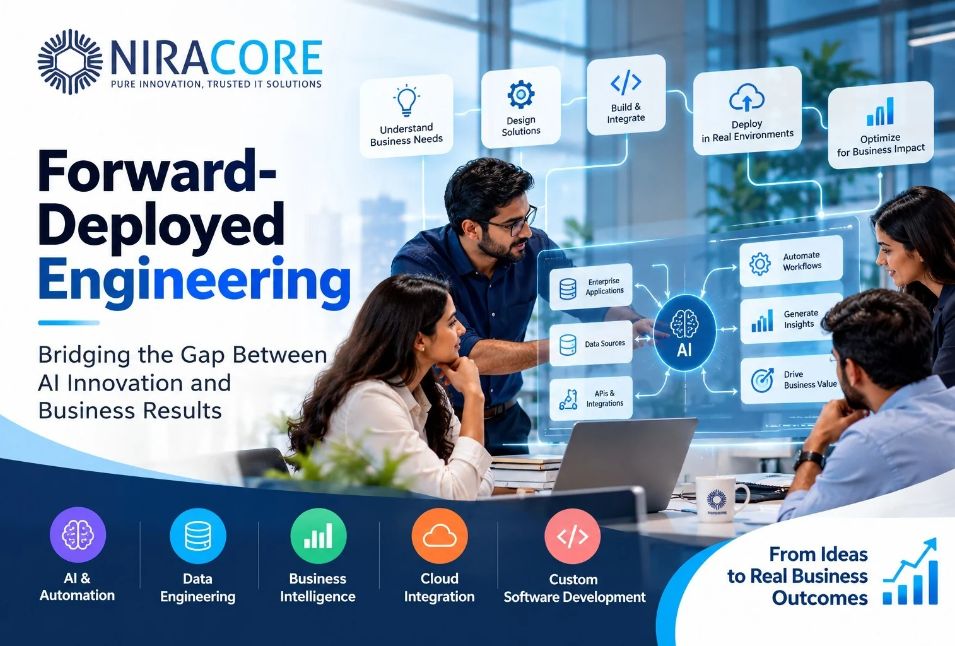
Artificial intelligence is transforming how businesses develop products, analyze information, automate operations, and serve customers. From generative AI assistants to intelligent data platforms, organizations have more opportunities than ever to improve efficiency through technology.
However, adopting a promising technology is only the beginning. The real challenge is making it work within an organization’s existing systems, business processes, data infrastructure, and operational requirements.
An AI application might perform exceptionally well in a demonstration but struggle when connected to real business data. A software prototype may solve a specific problem but fail to integrate with existing enterprise applications. Similarly, an automation initiative may work under ideal conditions but require substantial manual intervention when unexpected scenarios arise.
This is where forward-deployed engineering becomes valuable.
Forward-deployed engineering brings engineering expertise closer to the people, processes, and systems that need technological improvements. Instead of building solutions in isolation, engineers work directly with business stakeholders to understand operational challenges, develop practical solutions, integrate them into existing environments, and continuously improve their performance.
For organizations investing in AI, data engineering, and enterprise software, this approach can help bridge the gap between technological innovation and real business outcomes.
In this guide, we explore what forward-deployed engineering means, how it works, its business benefits, practical applications, and how organizations can determine whether this engineering model is right for them.
What Is Forward-Deployed Engineering?
Forward-deployed engineering is a software engineering approach in which engineers work closely with customers and operational teams to design, develop, integrate, and optimize technology solutions within real business environments.
Traditional development teams often work from predefined requirements, technical specifications, and project documentation. Although this model works well for many projects, complex enterprise challenges frequently require a deeper understanding of how people actually use technology.
Forward-deployed engineers help close that gap.
They collaborate with business users, understand existing workflows, investigate technical limitations, and translate operational requirements into working software. Their responsibilities can extend from initial discovery and solution architecture to development, deployment, monitoring, and continuous improvement.
The approach is particularly relevant to enterprise AI, where successful implementation depends on more than selecting a capable AI model.
Organizations must also address data access, application integration, security, business rules, exception handling, user experience, and performance evaluation.
Forward-deployed engineering connects these elements to create solutions that work in the context of actual business operations.
What Does a Forward-Deployed Engineer Do?
A forward-deployed engineer combines technical implementation skills with business understanding and direct stakeholder collaboration.
Depending on the project, responsibilities may include:
- Understanding operational challenges and identifying opportunities for improvement.
- Evaluating existing applications, databases, APIs, and infrastructure.
- Designing software architectures that address real business requirements.
- Integrating AI models and intelligent automation into existing workflows.
- Building data pipelines and connecting information from multiple sources.
- Developing APIs, internal tools, dashboards, and workflow applications.
- Testing reliability, security, performance, and edge cases.
- Establishing monitoring, evaluation, and maintenance processes.
- Collecting user feedback and improving solutions after deployment.
- Documenting the solution so internal teams can operate and extend it.
The objective is not simply to deliver software. It is to ensure that the software addresses the intended problem and can operate effectively in its target environment.
Why Are Businesses Adopting Forward-Deployed Engineering?
Many organizations have already invested in cloud infrastructure, analytics platforms, enterprise applications, and artificial intelligence. Yet these technologies do not always deliver their expected value.
The problem is often the connection between technical capabilities and everyday business processes.
Consider a company that wants to introduce an AI assistant for its customer support team. The assistant may generate useful responses, but a production-ready solution also needs access to approved knowledge sources, integration with the customer relationship management system, appropriate access permissions, escalation procedures, and mechanisms for evaluating response quality.
Without these components, the assistant may remain a limited experiment rather than becoming a dependable business tool.
Forward-deployed engineering addresses this implementation challenge by involving engineers in the actual environment where the solution will operate.
1. Moving Beyond AI Proofs of Concept
An AI proof of concept can demonstrate that a particular idea is technically feasible. However, feasibility alone does not establish whether the solution is secure, reliable, maintainable, or useful at scale.
Forward-deployed engineers help turn successful experiments into operational applications by addressing integration, testing, deployment, monitoring, and user adoption.
2. Solving Problems That Are Difficult to Specify in Advance
Some business challenges become clear only after engineers examine existing workflows and interact with the people performing the work.
Working closely with operational teams helps identify hidden dependencies, manual workarounds, data inconsistencies, and exceptions that may not appear in initial requirements.
This understanding supports better technical decisions and reduces the risk of developing solutions that look correct on paper but do not fit the business.
3. Connecting Technology With Measurable Outcomes
A successful engineering initiative should deliver more than completed development tasks.
It should support meaningful outcomes, such as reducing manual processing, improving reporting accuracy, shortening response times, increasing operational visibility, or helping employees make better-informed decisions.
Forward-deployed engineering encourages teams to define these outcomes early and evaluate the solution against them throughout implementation.
How Forward-Deployed Engineering Works
A successful engagement typically follows an iterative process. The exact activities and timelines depend on the complexity of the business problem, the availability of data, existing infrastructure, and the required level of integration.
Phase 1: Business Discovery and Workflow Assessment
The first step is understanding the business problem before selecting the technology.
Engineers work with stakeholders to examine current processes, identify operational bottlenecks, and understand how existing systems support daily activities.
Activities may include:
- Mapping current business workflows.
- Identifying repetitive tasks and manual handoffs.
- Reviewing databases, APIs, and enterprise applications.
- Assessing data availability and quality.
- Identifying security, compliance, and integration requirements.
- Establishing baseline performance metrics.
Deliverable: A clearly defined problem statement, a prioritized set of opportunities, and measurable success criteria.
Phase 2: Solution Architecture and Technical Planning
Once the problem is understood, engineers evaluate possible implementation approaches.
Depending on the requirements, the solution might involve conventional software development, workflow automation, data engineering, machine learning, generative AI, or a combination of these technologies.
The architecture should consider:
- Integration with existing applications.
- Data processing and storage requirements.
- Authentication and authorization.
- Infrastructure and deployment options.
- Performance and scalability.
- Error handling and recovery.
- Monitoring and ongoing maintenance.
Deliverable: A practical technical architecture and an implementation roadmap aligned with business priorities.
Phase 3: Development and Integration
During implementation, engineers develop the required components and connect them to the organization’s existing technology environment.
For an AI-powered solution, this might include integrating a language model with approved enterprise documents, connecting business APIs, implementing retrieval mechanisms, and introducing human approval steps for sensitive actions.
For a data-focused project, the work could involve building ETL or ELT pipelines, consolidating information from multiple systems, implementing data validation, and making trusted datasets available for reporting and analytics.
The emphasis remains on solving the defined business problem rather than introducing technology without a clear purpose.
Deliverable: A working solution integrated with the relevant systems and prepared for structured testing.
Phase 4: Testing, Validation, and Deployment
A solution that works in a development environment is not automatically ready for production.
Engineers must validate how it behaves under realistic conditions, including incomplete data, unexpected inputs, application failures, permission restrictions, and changing business requirements.
Testing may cover:
- Functional correctness.
- Data quality and consistency.
- Integration reliability.
- Security and access controls.
- Performance and scalability.
- AI output quality, where applicable.
- Exception handling and recovery.
- User acceptance.
For AI systems, evaluation should include representative examples and difficult edge cases. Human review should remain available wherever incorrect outputs could create significant business or operational risks.
Deliverable: A validated solution with deployment procedures, monitoring arrangements, and appropriate operational safeguards.
Phase 5: Monitoring, Optimization, and Scaling
Deployment is the beginning of operational learning, not the end of engineering.
Once employees start using the solution, engineers can identify usability issues, performance bottlenecks, unexpected scenarios, and opportunities for improvement.
The team can use operational metrics and stakeholder feedback to refine the implementation.
When the solution demonstrates consistent value, reusable components and integration patterns can help extend it to additional departments, business units, or workflows.
Deliverable: A maintainable solution with a defined improvement process and a roadmap for expansion.
Key Benefits of Forward-Deployed Engineering
1. Better Alignment Between Business and Technology
Direct collaboration between engineers and business users helps ensure that technical decisions reflect actual operational needs.
This can reduce misunderstandings, improve prioritization, and minimize the risk of delivering features that do not solve the underlying problem.
2. More Practical AI Implementation
Enterprise AI requires more than model selection. It must work with business data, existing applications, user permissions, and established operating procedures.
Forward-deployed engineers help address these requirements together, increasing the likelihood that AI capabilities become useful parts of everyday work.
3. Improved Integration With Existing Systems
Businesses rarely operate on a single application or database.
Connecting CRM platforms, ERP systems, data warehouses, APIs, and reporting tools requires careful engineering.
Forward-deployed teams can evaluate these dependencies early and build integrations that fit the existing environment.
4. Faster Feedback and Iteration
When engineers work closely with users, they can identify problems earlier and validate proposed improvements directly against real workflows.
This creates a practical feedback loop in which development decisions are informed by actual usage rather than assumptions alone.
5. Greater Operational Reliability
A production solution must handle errors, changing data, system interruptions, and unexpected scenarios.
By incorporating testing, monitoring, access controls, and recovery mechanisms into implementation, engineering teams can help improve reliability and maintainability.
6. Clearer Measurement of Business Value
Forward-deployed engineering encourages organizations to connect technical work with measurable business outcomes.
Depending on the use case, relevant metrics may include processing time, manual effort, error rates, report delivery time, system availability, or employee adoption.
The right metrics make it easier to determine whether the solution is achieving its intended purpose.
Real-World Applications of Forward-Deployed Engineering
Forward-deployed engineering can support different industries and technology environments. Its value depends on the complexity of the problem and the need to integrate a solution into existing operations.
Real-World Scenarios
Forward-deployed engineering can support many types of business technology initiatives. Its value is especially apparent when solutions must integrate with complex systems or adapt to changing operational requirements.
1. Enterprise AI and Workflow Automation
Businesses may want to automate document processing, customer support workflows, internal approvals, reporting, or other repetitive activities.
Implementing these capabilities requires more than connecting an AI model or configuring an automation tool.
The solution may need to integrate with enterprise applications, enforce access controls, validate outputs, handle exceptions, and provide a process for human review.
Forward-deployed engineers can help connect these components into a functioning business workflow.
Potential applications include:
- Intelligent document processing.
- AI-assisted customer service.
- Automated report preparation.
- Business process automation.
- AI-enabled knowledge retrieval.
- Human-reviewed decision-support workflows.
Relevant Niracore service: AI and Automation Solutions.
2. Data Engineering and Analytics
Organizations often struggle to consolidate data from multiple databases, applications, files, and cloud services.
Forward-deployed engineering can help establish reliable data pipelines, standardize transformations, implement data-quality checks, and prepare information for analytics.
For example, a business may need to combine sales, inventory, and order information to improve operational reporting.
The engineering work could involve extracting data from source systems, transforming inconsistent records, loading the results into an analytical environment, and validating the output with business users.
Potential technologies include Azure Data Factory, Azure Databricks, Microsoft Fabric, SQL databases, cloud storage, and other tools appropriate to the existing environment.
Relevant Niracore service: Data Engineering and Analytics.
3. Business Intelligence and Reporting
Many organizations rely on spreadsheets, manually prepared reports, and disconnected dashboards.
A forward-deployed engineering approach can help address the underlying data and integration problems rather than focusing exclusively on dashboard development.
The work may include:
- Connecting data from multiple sources.
- Establishing consistent business definitions.
- Automating data refresh and transformation.
- Developing analytical models.
- Building role-specific dashboards.
- Validating KPIs with business stakeholders.
- Improving reporting reliability and usability.
For example, a retailer may need a unified view of sales performance, inventory, product categories, and store operations.
The engineering solution should establish trustworthy data flows and business definitions before presenting the results in dashboards.
Relevant Niracore service: Power BI and Business Intelligence Solutions.
4.Legacy Application Modernization
Organizations may depend on older applications that remain important to daily operations but are difficult to maintain or integrate.
Replacing these systems immediately may be impractical because of cost, operational risk, or dependencies on other applications.
Forward-deployed engineers can help evaluate the existing environment and develop a suitable modernization approach.
Potential activities include:
- Integrating legacy applications through APIs.
- Replacing manual file transfers with managed integrations.
- Improving database performance.
- Separating tightly coupled application components.
- Migrating selected workloads to cloud platforms.
- Modernizing interfaces while preserving essential business logic.
The objective is to improve the technology environment without introducing unnecessary disruption.
Relevant Niracore service: Custom Software Development and Integration.
5.Cloud and Data Platform Integration
Moving workloads to the cloud does not automatically solve data fragmentation or operational inefficiencies.
Organizations may still need to integrate applications, establish data governance, configure access controls, automate deployments, and monitor system performance.
Forward-deployed engineering can help teams address these requirements within the context of their existing cloud architecture.
Potential work includes cloud integration, data platform implementation, automated deployment pipelines, observability, and performance optimization.
Relevant Niracore service: Cloud and Data Engineering Solutions.
Forward-Deployed Engineering vs. Traditional Software Development
Both approaches can produce excellent software. The main difference is how the engineering team engages with the business problem and remains connected to operational outcomes.
These models are not mutually exclusive. Traditional software development can also be collaborative, iterative, and outcome-driven.
Forward-deployed engineering is particularly useful when the problem is complex, the operational environment is difficult to understand in advance, or successful implementation requires frequent adjustments based on real-world feedback.
What Skills Does a Forward-Deployed Engineering Team Need?
Forward-deployed engineering requires a combination of technical expertise, business understanding, and communication skills.
The precise team composition depends on the project, but several capabilities are particularly important.
Software engineering: Engineers need to design, build, test, and maintain dependable applications, services, and integrations.
Data engineering: Understanding data pipelines, database design, data quality, and data access is essential for solutions that depend on enterprise information.
AI and machine learning: AI-focused engagements may require expertise in model integration, retrieval-augmented generation (RAG), AI agents, evaluation, and production monitoring.
Cloud and DevOps: Deployment automation, infrastructure management, security, observability, and release practices help make solutions maintainable in production.
System integration: APIs, authentication, application interoperability, and enterprise architecture are critical when connecting new capabilities to existing platforms.
Business analysis and product thinking: Engineers must understand user needs, evaluate trade-offs, and prioritize features according to business value.
Communication and collaboration: Working directly with business stakeholders requires explaining technical decisions clearly and incorporating feedback constructively.
A multidisciplinary team can combine these capabilities rather than expecting every engineer to be an expert in every area.
How to Choose the Right Forward-Deployed Engineering Partner
Selecting an engineering partner requires more than evaluating technology skills or comparing hourly rates.
Organizations should assess whether a potential partner can understand the business problem, work effectively with internal teams, and support the solution beyond its initial development.
Consider the following factors.
Understand Their Discovery Process
Ask how the team evaluates business workflows, identifies technical constraints, and defines success criteria before development begins.
A structured discovery process can reduce the risk of building a technically impressive solution that fails to address the real problem.
Evaluate Relevant Technical Experience
Look for experience in the technologies and integration patterns relevant to your project, such as cloud platforms, enterprise APIs, data engineering, AI systems, and custom software development.
Relevant implementation experience is generally more useful than a long list of technologies without evidence of practical application.
Review Their Approach to Security and Governance
Discuss data access, intellectual property, deployment permissions, sensitive information, auditability, and operational responsibilities.
For AI projects, also clarify how the team will evaluate outputs, handle uncertainty, and introduce human oversight when needed.
Establish Ownership and Knowledge Transfer
Your organization should understand who owns the source code, documentation, configurations, and other project deliverables under the agreed contract.
The engagement should also include appropriate documentation and knowledge transfer so your internal team can maintain and extend the solution.
Define Success Before Starting
Agree on a small set of measurable outcomes before implementation.
For example, a workflow automation project might aim to reduce average processing time, while a data engineering initiative might focus on improving data freshness or reducing reporting errors.
Specific targets should be based on an established baseline rather than assumed improvements.
Is Forward-Deployed Engineering Right for Your Business?
Forward-deployed engineering may be a strong fit if your organization is facing challenges such as:
- AI pilots that have not progressed into production.
- Disconnected applications and fragmented data sources.
- Manual processes that are difficult to automate with standard tools.
- Legacy systems that require modernization and integration.
- Business requirements that evolve as users test new solutions.
- Complex operational workflows that need custom software.
- Technology initiatives that lack clear links to measurable business outcomes.
However, this model may be unnecessary for a small, well-defined development task with stable requirements and limited integration complexity.
The right choice depends on the problem, the operating environment, the level of uncertainty, and the expertise available within your organization.
A focused assessment can help determine whether forward-deployed engineering, conventional software development, or a combination of both offers the most practical approach.
Comparison Table: Traditional Software Development vs. Forward-Deployed Engineering
Comparison Area | Traditional Software Development | Forward-Deployed Engineering |
Requirements | Often based on predefined specifications | Refined through direct operational collaboration |
Business interaction | Depends on the delivery model | Typically close collaboration with users |
Problem discovery | Often in defined discovery activities | Can continue throughout implementation |
Development approach | Fixed plan or iterative delivery | Iterative, outcome-focused implementation |
System integration | Defined by project scope and architecture | Informed by the target environment |
Feedback | Established review processes | Frequent feedback from operational users |
Success measurement | May emphasize scope, schedule, quality | Additional emphasis on operational impact |
Best suited for | Clearly defined software requirements | Complex problems needing close collaboration |
Illustrative ROI Calculation
Consider a hypothetical business process that requires 10 employees to spend two hours per working day preparing reports.
Assume the company has 22 working days per month.
Current monthly effort:
10 employees × 2 hours × 22 days = 440 hours per month.
Suppose an automation solution reduces the manual effort required for this process by 50%.
Estimated monthly time saved:
440 hours × 50% = 220 hours per month.
If the fully loaded labor cost is assumed to be ₹600 per hour, the estimated value of the released capacity is:
220 hours × ₹600 = ₹132,000 per month.
Under these assumptions, the annualized value of the released capacity would be ₹1,584,000.
This is an illustrative calculation, not a verified Niracore client result.
The estimated value represents released employee capacity, not necessarily an equivalent reduction in cash expenditure. Actual financial benefits depend on how the organization uses the time saved.
A complete ROI calculation should also account for implementation costs, software subscriptions, infrastructure, maintenance, training, and other relevant expenses.
One possible calculation is:
ROI (%) = (Net Financial Benefit ÷ Total Investment) × 100
Where:
Net Financial Benefit = Measurable Financial Benefits − Total Investment
The evaluation period and cost assumptions should be consistent. For a more reliable business case, include only benefits that can be reasonably measured and attributed to the solution.
What Does Forward-Deployed Engineering Cost?
There is no universal price for a forward-deployed engineering engagement.
The cost depends on the scope of the problem, the engineering expertise required, the existing technology environment, and the level of implementation and support needed.
Factors That Influence Cost
1. Engineering expertise
Projects requiring specialized AI, cloud architecture, data engineering, security, or legacy-system expertise may have different staffing requirements from straightforward application integrations.
2. Project complexity
A single API integration is generally different in scope from a multi-system implementation involving data migration, AI, workflow changes, and production monitoring.
3. Data readiness
Inconsistent, incomplete, or inaccessible data may require additional assessment, cleansing, transformation, and validation.
4. Existing infrastructure
The availability of documented APIs, reliable environments, and established deployment processes can influence implementation effort.
5. Security and compliance requirements
Access controls, auditability, data protection, and industry-specific requirements may introduce additional engineering and validation work.
6. Ongoing support
Projects requiring continued monitoring, maintenance, optimization, or operational support need an appropriate long-term arrangement.
Common Engagement Models
Organizations may consider several commercial approaches:
- Fixed-scope project: Suitable when requirements, deliverables, and acceptance criteria are sufficiently clear.
- Time-and-materials engagement: Suitable when the scope may evolve as technical discoveries are made.
- Dedicated engineering capacity: Suitable when a business needs sustained engineering support across multiple workstreams.
- Discovery and assessment engagement: Suitable when the problem is not fully understood and the organization needs a technical assessment before committing to implementation.
The right model depends on the level of uncertainty, the desired deliverables, and the responsibilities assigned to each party.
Before starting, agree on scope, milestones, ownership, acceptance criteria, communication processes, and change-control arrangements.
How Niracore Can Help Turn Engineering Into Business Value
At Niracore, we believe technology should solve practical business problems rather than add unnecessary complexity.
Organizations investing in AI, business intelligence, data engineering, and custom software often need more than an isolated technical component. They need solutions that connect with existing systems, support business workflows, and provide a foundation for continued improvement.
Our technology capabilities span business intelligence and analytics, data engineering, AI and automation, cloud integration, and custom software development.
Depending on your requirements, an engagement may involve:
- AI and automation: Identifying suitable workflows and integrating AI capabilities into businessapplications.
- Data engineering: Connecting data sources and building dependable pipelines for operationalreporting and analytics.
- Business intelligence: Developing dashboards and reporting solutions that help teams monitorperformance and make informed decisions.
- Custom software development: Building applications, APIs, and integrations tailored to specificoperational requirements.
- Cloud integration: Connecting business systems and supporting scalable, maintainable technologyarchitectures.
We approach each engagement by understanding the business objective, evaluating the technical environment, and identifying an implementation path that fits the organization’s needs.
For businesses exploring forward-deployed engineering, this outcome-oriented approach can provide a practical starting point for moving from an initial idea to a working solution.
Have a business workflow that needs better automation, more reliable data, or a practical AI implementation strategy?
Visit Niracore to explore our technology services and discuss your requirements.
Conclusion
Forward-deployed engineering represents a practical way to connect software development with the operational realities of a business.
By combining engineering expertise, direct stakeholder collaboration, system integration, and continuous evaluation, organizations can address the challenges that often separate a promising technical idea from a useful production solution.
The approach is especially valuable when businesses need to integrate AI, modernize existing applications, consolidate data, or automate complex workflows.
Ultimately, successful implementation is not defined by the sophistication of the technology alone. It depends on whether the solution addresses a genuine business need, operates reliably in its intended environment, and delivers measurable value.
For organizations evaluating their next AI, data, or software initiative, the best starting point is to identify a meaningful operational problem, establish clear success criteria, and select an engineering approach that supports those goals.
FAQs
Forward-deployed engineering is an approach in which engineers work closely with business teams to understand real operational problems and build technology solutions directly suited to their environment. The work may include software development, system integration, AI implementation, deployment, and ongoing improvement.
A software engineer primarily focuses on designing, building, testing, and maintaining software. A forward-deployed engineer performs engineering work while also collaborating closely with customers and operational teams to understand the problem, adapt the solution to the business environment, and validate its practical impact. The responsibilities can overlap considerably.
It helps connect AI capabilities to enterprise data, applications, business rules, and operational workflows. Engineers can also implement evaluation processes, access controls, monitoring, and human review mechanisms to support reliable production use.
No. Although it is increasingly relevant to enterprise AI implementation, the approach can also support data engineering, cloud integration, legacy modernization, workflow automation, and custom enterprise software development.
Staff augmentation typically adds individual professionals to an existing team to work under the client’s management and priorities. Forward-deployed engineering emphasizes close collaboration with operational stakeholders and may involve a multidisciplinary team responsible for implementing and improving a defined solution. The exact responsibilities depend on the engagement agreement.
Success should be measured against business objectives established before implementation. Depending on the use case, metrics might include processing time, manual effort, data accuracy, application reliability, user adoption, operating costs, or customer response times.
Timelines depend on the complexity of the problem, system dependencies, data readiness, security requirements, and deployment scope. A focused assessment may take substantially less time than a project involving multiple enterprise systems and production AI workflows. A phased implementation can help organizations validate value before committing to a larger rollout.