
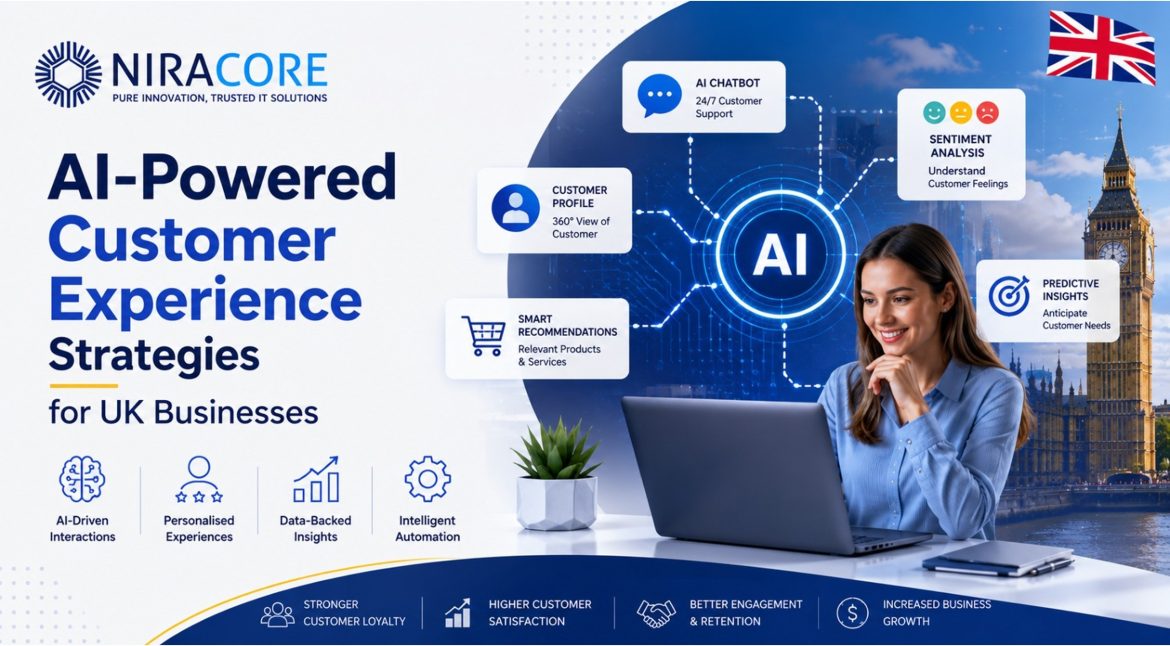
AI-Powered Customer Experience Strategies are no longer a side discussion for UK leadership teams. They now sit close to revenue, retention, operational cost and brand trust. When a customer waits too long for support, receives irrelevant offers, or repeats the same issue across channels, the problem is rarely just service quality. It is usually a data, process and technology problem sitting underneath the experience.
From what we’ve seen across enterprise data projects, many companies already have useful customer data. The issue is that it lives in too many systems: CRM, support platforms, web analytics, call centers, ERP, spreadsheets and marketing tools. By the time leaders get a clear picture, the customer has already moved on.
This is where AI customer experience UK initiatives are becoming more practical. The goal is not to replace human service teams. The goal is to give them better context, faster insight and smarter automation. But leadership needs to be careful. A chatbot added to a broken process will only make the broken process faster. AI works best when customer journeys, data quality and operating ownership are fixed first.
Why Decision-Makers Are Looking at AI CX Now
Customer expectations in the UK have changed. People expect quick replies, consistent information and personalised customer experience across web, phone, email, WhatsApp and live chat. Still, many companies are running customer experience with disconnected systems.
Here’s the challenge. AI customer service solutions need trusted data. If customer records are duplicated, incomplete or outdated, AI recommendations become weak. Budget is rarely the biggest obstacle. Alignment between business and technology teams often is.
A mistake many leadership teams make is treating AI CX strategy for UK businesses as a tool selection exercise. In reality, the better question is: which customer moments create the most cost, delay or frustration?
Where AI Creates Real Business Value
The companies getting the best results usually start with focused use cases. AI chatbots for businesses can handle routine questions. Generative AI customer support can help agents draft faster responses. Predictive customer analytics can identify churn risk before the customer complains. Sentiment analysis for customer feedback can highlight service issues hidden inside reviews, calls and surveys.
Customer experience automation also helps when repetitive workflows slow teams down. For example, ticket routing, refund checks, appointment reminders and follow-up messages can be improved with AI-driven customer engagement.
But AI should not remove judgement. It should support better judgement.
Practical Business Scenarios
Scenario 1: A healthcare provider has patient enquiries coming from phone, email and website forms. The service team is working hard, but fragmented records create delays. AI can help classify enquiries, surface patient history and route urgent cases faster.
Scenario 2: A manufacturing company receives service requests from distributors, engineers and customers. Reporting takes days because data sits across multiple systems. With data engineering and analytics, leaders can see recurring product issues and service bottlenecks sooner.
Scenario 3: A retail business wants better forecasting and more relevant customer offers. Predictive customer analytics can identify buying patterns, seasonal demand and customer segments that need different messaging.
What Leaders Should Watch Carefully
One surprising finding is that AI projects often fail before the model is even selected. Poor data ownership, unclear KPIs and weak process design cause more damage than technology limitations.
Leaders should define success clearly. Is the goal faster response time? Lower support cost? Better retention? Higher conversion? Stronger Omni channel customer experience? Without that clarity, AI becomes activity rather than progress.
Future Outlook for AI CX in the UK
The next phase will move beyond basic chatbots. More UK businesses will use customer journey automation, AI agents, real-time analytics and connected decision systems. Agentic AI will play a larger role where tasks require planning, reasoning and action across systems.
Yet the strongest results will still come from disciplined execution: clean data, focused use cases, secure architecture and business ownership.
AI Customer Experience Strategies for Modern UK Businesses
Niracore: AI Customer Experience Strategies for Modern UK Businesses is becoming an important topic for organizations that want to improve customer service, automate support processes, and deliver more personalised customer experiences through artificial intelligence. Today, UK businesses are looking beyond basic digital tools and focusing on AI-powered systems that can help them understand customer behaviour, respond faster, improve engagement, and make smarter business decisions.
AI-Powered Customer Experience Strategies for UK Businesses include the use of AI customer service solutions, generative AI customer support, AI chatbots, predictive customer analytics, sentiment analysis, customer journey automation, and omnichannel customer experience systems. These solutions help businesses manage customer interactions more efficiently across websites, mobile apps, email, chat, social media, and support platforms.
With strong expertise in AI Development, Agentic AI Development, Data Engineering, Data Analytics, Business Intelligence, Power BI, Microsoft Fabric, and Digital Transformation, Niracore helps UK businesses design practical AI CX strategies that are aligned with real business goals. Instead of only adding AI tools, the focus is on building secure, scalable, and data-driven customer experience systems that improve service quality, reduce manual work, and support long-term growth.
AI-powered customer experience solutions can support many business needs, including faster customer query handling, personalised recommendations, automated ticket routing, customer feedback analysis, churn prediction, and intelligent decision-making. For modern UK businesses, these strategies can improve operational efficiency, strengthen customer trust, increase team productivity, and create a more consistent customer journey.
How Niracore Helps
Niracore helps organisations design and implement practical AI-powered customer experience strategies through AI Development, Agentic AI Development, Microsoft Fabric Consulting, Power BI Development, Data Engineering, Data Analytics, Business Intelligence, Custom Software Development and Digital Transformation.
The work starts with business priorities, not tools. Then the right data foundation, AI solution and reporting layer are built around measurable outcomes.
Conclusion
AI-Powered Customer Experience Strategies can help UK businesses improve speed, personalisation, service quality and decision-making. But success depends on more than adopting AI. It depends on connecting customer data, fixing process gaps and choosing use cases that matter to the business.
FAQs
AI can improve response speed, personalise communication, predict customer needs and help teams make better service decisions.
No. Chatbots help, but real automation also needs clean data, proper workflows and integration with business systems.
The biggest risk is building AI on poor-quality or fragmented customer data.
Yes. It can draft replies, summarise conversations and suggest next actions, while humans handle judgement and sensitive issues.
Retail, healthcare, finance, manufacturing, SaaS, professional services and customer-heavy businesses can benefit.