
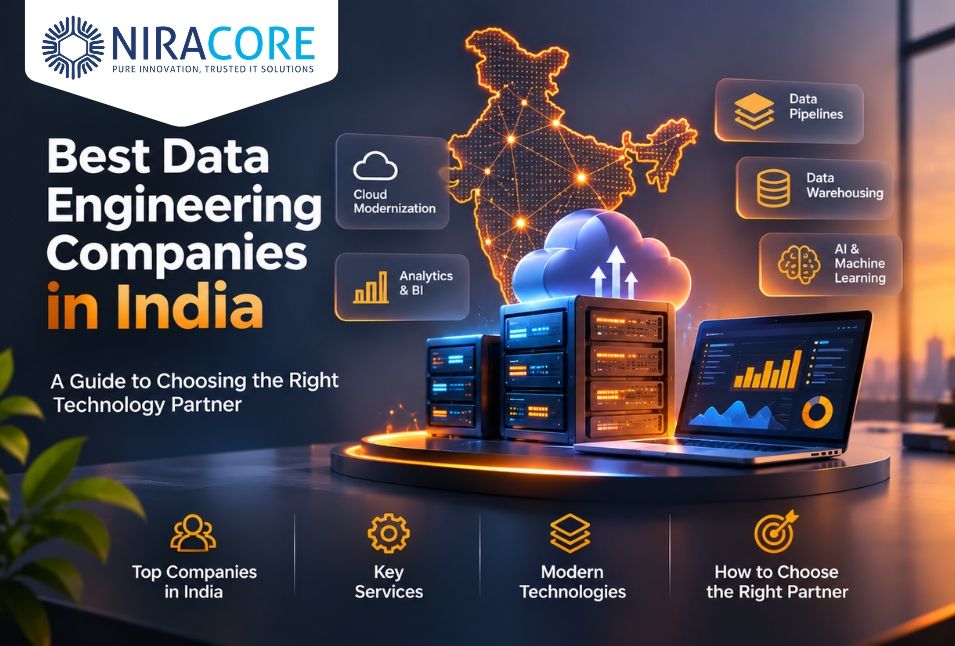
Businesses today generate data from almost every activity, including customer transactions, websites, mobile applications, supply chain operations, financial systems, and connected devices. However, collecting data is only the first step. The real challenge is transforming information from multiple sources into a reliable, accessible, and valuable business asset.
Many organizations still operate with disconnected databases, manually maintained spreadsheets, inconsistent reports, and data pipelines that struggle as business requirements grow. These limitations can delay decision-making, increase operational costs, and make it difficult to implement advanced analytics or artificial intelligence.
This is where data engineering becomes essential.
A well-designed data engineering ecosystem connects business applications, automates data movement, improves information quality, and creates a dependable foundation for reporting, analytics, and AI. Choosing the right technology partner can help organizations build this foundation without unnecessary complexity or investment.
India has become an attractive destination for businesses seeking data engineering expertise, cloud modernization, analytics implementation, and dedicated technology teams. Companies can access experienced professionals, flexible engagement models, and expertise across modern data platforms.
In this guide, we explore the role of data engineering, the services businesses should consider, technologies shaping modern data platforms, and companies worth evaluating when selecting a data engineering partner in India.
What Is Data Engineering?
Data engineering is the discipline of designing, building, and maintaining systems that collect, process, transform, store, and deliver data for business use. It involves developing the infrastructure and workflows that allow information to move reliably between operational applications, databases, cloud platforms, and analytical systems. For example, a retail organization might maintain separate systems for billing, inventory, customer relationships, online sales, and supplier management. Without an integrated data platform, its management team may need to collect information from each system manually before preparing performance reports. A data engineering solution connects these sources, standardizes the information, applies business rules, and makes the resulting datasets available for reporting and analysis. The same principles apply to manufacturing, healthcare, financial services, logistics, and software businesses.
Core Components of Data Engineering
- Data ingestion: Collecting information from databases, APIs, files, applications, and streaming sources.
- Data transformation: Cleaning, validating, combining, and restructuring data according to business requirements.
- Data storage: Organizing information in databases, data warehouses, data lakes, or lakehouse platforms.
- Data orchestration: Scheduling and coordinating data workflows so that processing jobs execute in the correct sequence.
- Data quality management: Identifying missing values, duplicate records, inconsistent formats, and other problems that could affect reporting.
- Data governance and security: Managing access, ownership, lineage, retention, and compliance requirements.
Together, these components create a reliable data foundation that supports business intelligence, advanced analytics, machine learning, and operational decision-making.
Why Data Engineering Matters for Modern Businesses
Investing in data engineering is not simply a technology decision. It can directly influence how efficiently an organization operates and how confidently its leadership makes decisions. Here are some of the most important business benefits.
1 Integrating Disconnected Business Systems
Organizations often use different applications for finance, sales, inventory, customer management, and operations. These systems may store information in different formats and follow different business rules. Data engineering connects these environments and creates consistent datasets that teams can use across departments. For example, a sales dashboard becomes more useful when sales transactions, product information, inventory availability, and customer data can be analyzed together.
2 Improving Data Quality and Reporting Accuracy
Inconsistent information creates uncertainty. Two departments might report different revenue figures because they use different calculation rules, refresh schedules, or source systems. Data engineering addresses these problems by introducing standardized transformations, validation rules, reconciliation processes, and reusable business logic. The result is a more dependable foundation for management reporting and operational analysis.
3 Reducing Manual Data Processing
When employees repeatedly download spreadsheets, combine files, correct formatting, and prepare reports manually, valuable time is spent maintaining data rather than using it. Automated data pipelines can perform these tasks on a scheduled or event-driven basis. This reduces repetitive work and allows business teams to focus on interpreting results, identifying opportunities, and improving processes.
4 Supporting Business Growth
A data architecture that works for a small business may become inefficient when transaction volumes, customers, and reporting requirements increase. Scalable data engineering helps organizations accommodate growing workloads through appropriate storage design, distributed processing, cloud resources, and workload optimization. The objective is to create a platform that can evolve with the business instead of requiring frequent architectural replacements.
5 Creating a Foundation for AI
Artificial intelligence depends on suitable data. Machine learning models require appropriately prepared datasets, while AI applications may need access to current, governed information from multiple business systems. Data engineering provides the ingestion, transformation, validation, and retrieval mechanisms needed to make this information available. Without reliable data infrastructure, even a technically sophisticated AI initiative can produce inconsistent or misleading results.
Why Consider a Data Engineering Company in India?
India offers a broad technology services ecosystem, making it a practical option for organizations looking to establish or expand their data engineering capabilities. However, cost should not be the only consideration when selecting a partner.
Access to Technical Expertise
Businesses can find engineering teams with experience across cloud computing, distributed data processing, database administration, data integration, analytics, and software development. Depending on the provider, this expertise may include Microsoft Azure, AWS, Google Cloud, Apache Spark, Databricks, Snowflake, Microsoft Fabric, and other technologies. The important factor is whether the proposed team has experience relevant to your architecture and business requirements.
Flexible Engagement Models
Organizations have different delivery needs. A startup might require one experienced data engineer for a short-term project, while an enterprise may need a dedicated team responsible for a long-term data modernization initiative. Many Indian technology providers support project-based delivery, dedicated engineering teams, staff augmentation, and ongoing managed services. These models allow businesses to choose an arrangement aligned with their internal capabilities and budgets.
Experience Supporting International Clients
Technology service providers in India frequently work with geographically distributed teams and international customers. When evaluating a provider, check its experience with your preferred working hours, communication expectations, documentation standards, security requirements, and delivery methodology. A suitable partner should be able to collaborate effectively with your internal stakeholders regardless of location.
Cost Efficiency and Resource Flexibility
Working with an Indian provider may help organizations manage technology budgets while accessing specialized skills. Nevertheless, the lowest initial quotation does not necessarily represent the best overall value. Consider the complete cost of delivery, including architecture, implementation, testing, cloud consumption, monitoring, maintenance, and future enhancements. A well-designed solution that reduces operational effort and avoids unnecessary infrastructure spending may deliver greater long-term value than a cheaper implementation that requires extensive rework.
Essential Data Engineering Services for Businesses
Before selecting a vendor, understand which services your organization actually needs. Data engineering encompasses several complementary capabilities.
1 Data Engineering Consulting and Architecture
Data engineering consulting helps businesses evaluate their existing data environment and define a practical modernization strategy. Typical activities include assessing current databases, applications, and integrations; identifying data silos and performance bottlenecks; designing scalable data architectures; selecting suitable cloud and processing technologies; establishing data quality and governance requirements; and preparing an implementation roadmap. A well-defined architecture helps prevent expensive technology decisions that do not align with business needs.
2 ETL and ELT Pipeline Development
ETL stands for Extract, Transform, Load. It involves extracting information, transforming it, and loading it into a target system. ELT stands for Extract, Load, Transform. It loads data into the target platform before performing transformations within that environment. Both approaches can be appropriate, depending on the source systems, processing requirements, target architecture, and security constraints.
Data engineering teams build automated pipelines that move information between operational databases, cloud storage, analytical platforms, and reporting systems. Common activities include incremental loading, change data capture, schema validation, error handling, retry mechanisms, and workflow scheduling.
3 Cloud Data Engineering and Migration
Many organizations want to modernize legacy infrastructure or consolidate data across different environments. Cloud data engineering helps them migrate databases, applications, and analytical workloads to suitable cloud platforms. The process may involve evaluating existing infrastructure and dependencies, selecting an appropriate target architecture, migrating historical and incremental data, validating records and business calculations, optimizing storage and compute resources, and establishing monitoring, access controls, and recovery procedures. A successful migration should preserve data integrity while minimizing disruption to business operations.
4 Data Warehousing, Data Lakes, and Lakehouses
Different workloads require different approaches to storing and managing information. Data warehouses are designed primarily for structured, analytical workloads and business reporting. Data lakes provide storage for large volumes of structured, semi-structured, and unstructured data. Lakehouse architectures combine elements of data lakes and data warehouses to support multiple analytical workloads on a shared data foundation. The right approach depends on data formats, query patterns, governance requirements, performance expectations, and the organization’s existing technology investments.
5 Real-Time Data Processing
Some business processes require information to be available almost immediately. Examples include payment monitoring, application event processing, equipment monitoring, inventory updates, and operational alerts. Streaming technologies and event-driven architectures can process incoming information continuously rather than waiting for a scheduled batch. However, real-time processing is not necessary for every use case. A good engineering partner should evaluate whether streaming, frequent incremental refreshes, or scheduled batch processing offers the best balance between business value, complexity, and cost.
6 Data Quality, Governance, and Observability
A pipeline that completes successfully is not necessarily producing correct data. Organizations also need mechanisms to detect unexpected changes, missing records, invalid values, delayed updates, and failed transformations. Data quality and observability solutions can monitor these conditions and alert teams when intervention is required. Governance capabilities help establish consistent definitions, access permissions, data lineage, and accountability. These practices are especially important when multiple departments depend on shared datasets or when sensitive information must be protected.
7 Business Intelligence and Analytics Integration
Data engineering and business intelligence work best when designed together. Engineering teams prepare and organize information, while analytics teams use that information to develop dashboards, reports, and analytical models. For example, a Power BI implementation may require optimized data models, reusable transformation logic, reliable refresh processes, and well-defined business metrics. A strong data engineering partner understands how upstream architecture decisions affect downstream reporting performance and usability.
A technology stack should be selected according to the business problem rather than current market popularity. The following platforms and tools are commonly used in modern data environments.
Technology | Primary Purpose | Typical Use Cases |
Microsoft Azure | Cloud infrastructure and data services | Enterprise data platforms and Microsoft-based environments |
Azure Data Factory | Data integration and pipeline orchestration | |
Azure Databricks | Distributed data processing and analytics | Large-scale transformations, data science, and machine learning |
Microsoft Fabric | Integrated analytics platform | |
AWS | Cloud infrastructure and managed data services | Cloud-native data platforms and distributed workloads |
Google Cloud | Cloud infrastructure and analytics services | |
Snowflake | Cloud data platform | Analytical workloads, data sharing, and warehouse modernization |
Google BigQuery | Managed analytical data warehouse | |
Apache Spark | Distributed data processing | Processing large datasets across distributed computing resources |
Apache Airflow | Workflow orchestration | |
PostgreSQL | Relational database management | Operational applications and structured data storage |
dbt | SQL-based data transformation and testing | Maintainable analytical models and transformation workflows |
How to Select the Right Technology Stack
- Existing investments: Determine whether your organization already uses Azure, AWS, Google Cloud, or Microsoft Fabric.
- Data volume and velocity: Evaluate the amount of information processed and how frequently it needs to be updated.
- Workload requirements: Separate operational reporting, advanced analytics, machine learning, and streaming requirements.
- Security and governance: Understand access control, residency, retention, and compliance obligations.
- Total cost of ownership: Estimate storage, processing, licensing, networking, support, and maintenance costs.
Data Engineering Companies in India to Consider
There is no universally applicable ranking of data engineering providers. The right choice depends on your industry, technology requirements, budget, project size, and expected level of support. The following shortlist places Niracore first as the featured provider, followed by other companies worth evaluating. This is an editorial shortlist for consideration, not an independently verified ranking of market share or overall performance.
1. Niracore
Niracore is an IT services company focused on business intelligence, data engineering, custom software solutions, cloud integration, and automation. For businesses seeking to improve their data infrastructure, an engagement can begin with understanding existing systems, identifying reporting or integration problems, and defining a practical implementation roadmap.
Depending on project requirements, relevant capabilities may include:
- Microsoft Azure data engineering.
- Azure Data Factory pipeline development.
- Azure Databricks and PySpark-based data processing.
- Microsoft Fabric and OneLake solutions.
- SQL Server and PostgreSQL database integration.
- Power BI reporting and analytics.
- Custom API and application integration.
- Workflow automation and data quality improvements.
Niracore’s combined focus on engineering and business intelligence is relevant when the objective is not simply to move data but to make it useful for operational reporting and business decisions. The company can be considered by startups, small and medium-sized businesses, and enterprises looking for a flexible technology partner for data engineering, analytics, and custom integration projects.
Potential fit: Businesses seeking a practical, integrated approach to data engineering, analytics, and software integration, particularly in Microsoft-oriented environments.
2. ValueCoders
ValueCoders provides software engineering services, including data engineering, data integration, and related technology capabilities. Organizations looking for external engineering resources or support with data infrastructure projects may wish to evaluate its delivery models.
Potential fit: Businesses seeking outsourced development capacity, engineering teams, or support for data platform implementation.
3. Radixweb
Radixweb is an established software engineering company offering capabilities across data engineering, cloud, AI, and enterprise software development. Its broader engineering portfolio may be relevant to organizations combining data modernization with application development or digital transformation.
Potential fit: Businesses seeking a software engineering partner with data and cloud capabilities.
4. Cybage
Cybage is a technology services company with a background in digital product engineering and enterprise technology solutions. Businesses evaluating providers for broader engineering initiatives may consider its capabilities alongside their specific data platform requirements.
Potential fit: Organizations looking for technology delivery support that may extend beyond data engineering alone.
5. Tredence
Tredence focuses on data science, analytics, and AI-related services, alongside data engineering capabilities. Organizations pursuing analytics-led transformation may consider how its data engineering services align with their analytical and machine learning requirements.
Potential fit: Businesses connecting data platform development with advanced analytics and AI initiatives.
6. Apexon
Apexon provides digital engineering and technology services, including capabilities relevant to data and analytics initiatives. Its wider engineering portfolio may be worth considering when data platform development is part of a larger modernization program.
Potential fit: Organizations seeking data capabilities alongside broader digital engineering services.
7. Indium
Indium offers digital engineering, software development, and data-related technology services. Businesses should evaluate its specific expertise against their requirements for data integration, analytical infrastructure, testing, and modernization.
Potential fit: Organizations considering an external technology partner for data and digital engineering initiatives.
8. Terralogic
Terralogic provides technology services spanning software engineering, cloud, infrastructure, and related enterprise requirements. Companies considering a broader technology engagement can assess whether its service portfolio and delivery model fit their data engineering needs.
Potential fit: Businesses looking for technology services that combine infrastructure and application capabilities.
9. Straive
Straive operates in data solutions, analytics, and technology-enabled services. Organizations with substantial information processing, data management, or analytics requirements may wish to evaluate its offerings against their operational needs.
Potential fit: Businesses evaluating data-centric services and analytics support.
How to Choose the Right Data Engineering Partner
Selecting a data engineering company is a strategic decision. A vendor may have an impressive technology portfolio but still be unsuitable for your specific business problem. Use the following criteria to evaluate potential partners.
1 Evaluate Relevant Project Experience
Ask whether the company has implemented solutions similar to yours. For example, a business modernizing Microsoft SQL Server reporting into Microsoft Fabric needs different expertise from a company building a high-volume streaming platform on AWS. Request relevant project examples, architectural explanations, and measurable outcomes where the vendor can share them.
2 Assess Architecture and Engineering Skills
A capable data engineering team should understand more than individual tools. Look for experience with data architecture and dimensional modeling; ETL/ELT pipeline development; SQL optimization and distributed processing; data quality testing and reconciliation; security, access control, and governance; performance monitoring and cost optimization; and deployment automation and production support. The team should be able to explain why a proposed architecture fits your requirements and what trade-offs it introduces.
3 Understand the Delivery Process
A reliable provider should establish clear responsibilities, milestones, deliverables, and communication channels. Ask how requirements are documented, how changes are handled, and how testing and acceptance are managed. You should also understand who will maintain the platform after implementation.
4 Review Security and Data Ownership
Before granting access to business systems, clarify how information will be protected. Evaluate access controls, encryption, audit logging, data handling procedures, and applicable compliance obligations. Your agreement should also define ownership of source code, pipeline definitions, documentation, data models, and other project deliverables.
5 Compare the Complete Cost
Compare proposals using a common scope rather than looking only at hourly rates. Include implementation, cloud consumption, software licenses, support, monitoring, future enhancements, and knowledge transfer. A slightly higher initial investment may be worthwhile if it produces a more maintainable platform with lower ongoing operational costs.
6 Start With a Clearly Defined Pilot
For a complex project, consider a limited proof of concept or discovery engagement. A pilot might integrate two data sources, automate one reporting workflow, or demonstrate a migration from an existing database into a target platform. Agree on measurable success criteria before development begins. This approach helps validate the architecture and delivery process before expanding the scope.
Common Data Engineering Challenges and Their Solutions
Challenge 1: Inconsistent Information Across Systems
Problem: Different applications use different customer identifiers, product codes, date formats, or business definitions. Solution: Establish standardized data models, validation rules, and transformation logic. Create clear definitions for important business entities and metrics.
Challenge 2: Slow Data Pipelines
Problem: Large tables, inefficient queries, unnecessary data movement, and poorly designed transformations cause processing delays. Solution: Profile workloads, optimize SQL, use incremental processing where appropriate, and select suitable compute resources. Measure performance before and after making changes.
Challenge 3: Unpredictable Cloud Costs
Problem: Oversized clusters, excessive data duplication, inefficient queries, and unnecessary scheduled jobs increase operating expenses. Solution: Monitor resource consumption, right-size workloads, optimize storage, and review pipeline schedules. Introduce cost alerts and assign ownership for major workloads.
Challenge 4: Limited Data Visibility
Problem: Teams cannot determine whether datasets are current, where information originated, or which processes caused an error. Solution: Implement pipeline monitoring, data lineage, execution logs, quality checks, and actionable alerts.
Challenge 5: Difficulty Scaling Existing Infrastructure
Problem: Systems designed for limited workloads struggle as data volume and concurrent usage increase. Solution: Evaluate architecture bottlenecks, separate workloads where necessary, optimize data models, and introduce scalable processing patterns.
The important principle is to diagnose the underlying issue before investing in new technology. Not every performance or quality problem requires a complete platform replacement.
Industry Applications of Data Engineering
Retail and E-Commerce
Retailers need to combine sales transactions, inventory, product information, customer behavior, and supplier data. An integrated data platform can support sales and profitability analysis, inventory visibility and replenishment planning, customer segmentation, product performance reporting, and promotion effectiveness analysis. For example, integrating point-of-sale and inventory data allows managers to identify products that sell quickly but repeatedly become unavailable.
Manufacturing
Manufacturing organizations collect data from production systems, equipment, quality inspections, inventory applications, and enterprise resource planning platforms. Data engineering can combine these sources to support production monitoring, quality analysis, maintenance planning, and operational reporting. The value comes from making information available consistently across production, quality, supply chain, and management teams.
Healthcare
Healthcare organizations must manage information from multiple systems while protecting sensitive data. Data engineering can help integrate operational, administrative, and clinical datasets for approved reporting and analytical use cases. Projects should incorporate appropriate access controls, data minimization, auditability, and applicable privacy requirements.
Financial Services
Banks, insurers, and financial service providers rely on accurate and timely information for reporting, reconciliation, risk analysis, and operational monitoring. Data engineering helps consolidate information from multiple systems while supporting validation, traceability, and controlled access.
Logistics and Supply Chain
Logistics businesses often need to combine shipment records, warehouse activity, fleet information, delivery events, and customer orders. A well-designed data platform can provide improved visibility into delivery performance, inventory movement, route efficiency, and operational bottlenecks.
Software and Technology Companies
Software businesses generate data from applications, customer interactions, product usage, infrastructure monitoring, and billing systems. Data engineering can turn these sources into reliable product analytics, customer retention reporting, usage metrics, and operational dashboards.
How Data Engineering Supports AI and Business Intelligence
Data engineering, business intelligence, and artificial intelligence are closely connected, but they serve different purposes. Data engineering prepares and delivers trustworthy information. Business intelligence transforms that information into reports, dashboards, and performance indicators. Artificial intelligence and machine learning use suitable data to support prediction, classification, recommendation, and automation.
Consider a company that wants to predict which products may experience stock shortages. First, data engineering combines historical sales, current inventory, supplier lead times, and replenishment records. Next, analytical models organize these datasets and expose relevant business measures. A forecasting model can then use suitable historical information to estimate future demand. Finally, dashboards or operational applications can present the results to the teams responsible for inventory decisions. Each component depends on the quality of the preceding stages.
Building an AI-Ready Data Platform
- Reliable access to relevant data sources.
- Consistent data definitions and validation.
- Secure access to sensitive information.
- Documented data lineage and transformation logic.
- Appropriate historical data retention.
- Repeatable processes for preparing model inputs.
- Monitoring for data changes that could affect model performance.
AI readiness does not necessarily require building a large, complex platform immediately. A well-scoped project with reliable data and clear business objectives can be a more effective starting point.
Steps to Implement a Successful Data Engineering Strategy
Step 1: Define the Business Objective
Start with the problem rather than the technology. Examples include reducing manual reporting effort, improving data consistency, modernizing legacy infrastructure, or enabling faster operational decisions. Identify the stakeholders who will use the resulting data platform.
Step 2: Assess the Current Environment
Document data sources, databases, integrations, existing pipelines, reporting dependencies, security requirements, and known limitations. This assessment helps identify which components should be retained, optimized, replaced, or integrated.
Step 3: Design the Target Architecture
Select appropriate storage, processing, orchestration, and analytics components. Define how information will move through the platform and how quality, security, monitoring, and access control will be managed.
Step 4: Prioritize High-Value Use Cases
Avoid attempting to modernize every system simultaneously. Choose a use case that offers meaningful business value and can be implemented within a manageable scope. A reporting pipeline or integration supporting a critical business process can be a suitable starting point.
Step 5: Build and Validate the Pipelines
Develop the ingestion and transformation workflows, implement quality checks, and test expected behavior. Validation should include record counts, business calculations, duplicate handling, error recovery, and performance under realistic workloads.
Step 6: Deploy With Monitoring
Move the solution into production using appropriate deployment and access controls. Set up monitoring for failures, data delays, unexpected schema changes, and resource consumption. Document operational procedures and escalation responsibilities.
Step 7: Measure Results and Improve
Evaluate whether the implementation achieved its original objectives. Depending on the use case, useful metrics may include data pipeline success rate, data freshness and availability, reporting preparation time, data quality failure rate, query and processing performance, cloud expenditure per workload, and time required to resolve production incidents. Use these findings to prioritize the next phase of improvements.
Conclusion: Build a Data Foundation That Supports Your Business Goals
Data engineering has become an important capability for organizations that want to improve reporting, integrate business systems, modernize infrastructure, and prepare for advanced analytics and AI. However, success depends on more than choosing a popular platform or hiring a large development team. Businesses need an architecture aligned with their objectives, dependable data pipelines, effective quality controls, appropriate security, and a clear plan for ongoing maintenance.
India offers a wide range of technology service providers, from specialized engineering teams to large digital transformation companies. The right partner is the one that understands your business challenges, demonstrates relevant technical expertise, and can deliver a maintainable solution within your constraints.
For organizations exploring data engineering, Microsoft Fabric, Azure Data Factory, Azure Databricks, database integration, or Power BI modernization, a focused assessment can help identify the most practical starting point.
Looking for Data Engineering Support?
Niracore helps businesses explore data engineering, business intelligence, custom software development, and automation solutions aligned with their operational needs. Whether you are integrating multiple data sources, improving pipeline reliability, modernizing your analytics infrastructure, or preparing data for AI initiatives, the first step is understanding your current environment and defining the outcome you want to achieve.
Let’s discuss your data engineering requirements and identify a practical path toward a more reliable, scalable, and business-ready data platform.
Visit https://niracore.com/
to learn more about Niracore’s services and discuss your project requirements.
FAQs
A data engineering company designs, builds, integrates, and maintains systems that collect, process, store, and deliver data. Its services may include data pipeline development, cloud migration, data warehousing, data quality management, architecture consulting, and analytics integration.
Costs depend on project scope, technical complexity, data volume, platform selection, team composition, security requirements, and support expectations. A small integration project may require substantially less investment than an enterprise-wide modernization initiative. Businesses should request a scoped proposal that distinguishes implementation fees from ongoing infrastructure and maintenance costs.
Common technologies include Python, SQL, Apache Spark, Azure Data Factory, Azure Databricks, Microsoft Fabric, AWS data services, Google Cloud, Snowflake, BigQuery, and Apache Airflow. The appropriate combination depends on existing infrastructure, workload requirements, data governance, and budget.
Data engineering focuses on making data available, reliable, organized, and suitable for use. Data analytics focuses on examining that information to identify trends, answer business questions, measure performance, and support decisions. Both disciplines work together to turn raw information into business value.
Timelines vary according to the number of source systems, data quality, architecture complexity, migration requirements, security constraints, and testing needs. A narrowly defined proof of concept may take considerably less time than a complete enterprise platform implementation. A realistic estimate should follow an initial assessment and clear definition of deliverables.
Microsoft Fabric can be suitable for organizations seeking an integrated analytics environment that combines data engineering, lakehouse capabilities, data warehousing, and Power BI. However, suitability depends on existing technology investments, workload characteristics, governance needs, licensing, and total cost of ownership.
Evaluate providers based on relevant project experience, architecture skills, technology expertise, security practices, delivery methodology, communication, support arrangements, and total cost. Ask for comparable project examples and define measurable acceptance criteria before beginning the engagement.
Yes. Small and medium-sized businesses can benefit from data integration and automation even without building a large enterprise data platform. A focused solution that combines sales, inventory, financial, or customer information may be enough to improve reporting and reduce manual effort.