
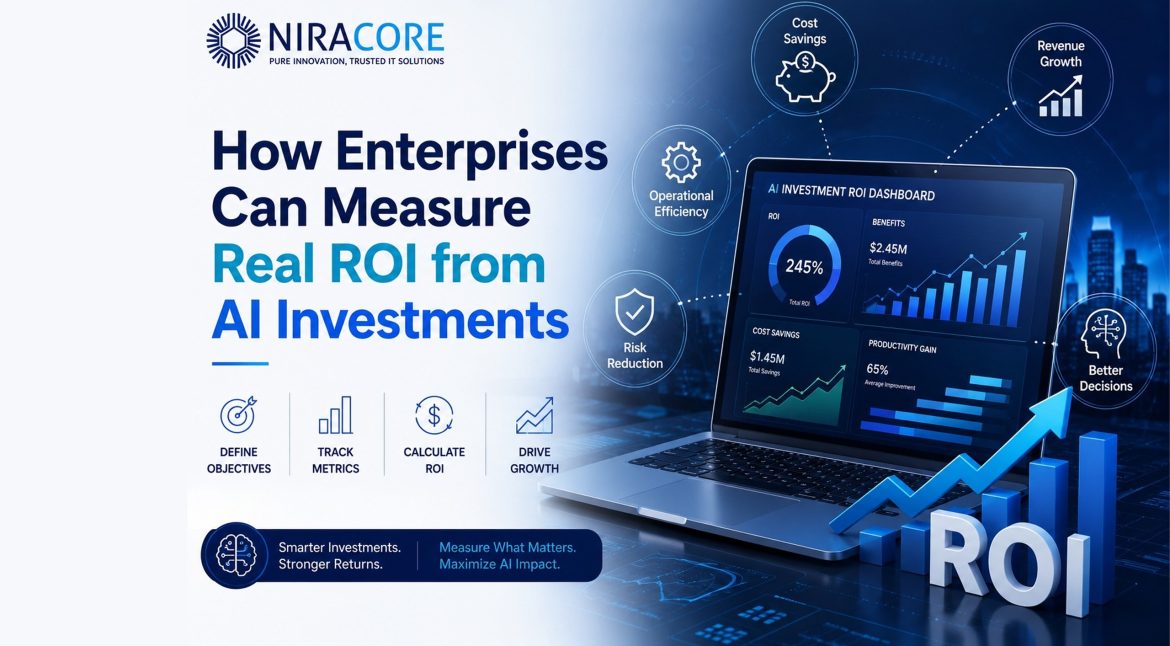
AI ROI Measurement is not a finance exercise added at the end of an AI project. It is a leadership discipline that should be designed before the first pilot starts. I have seen enterprises invest in AI pilots, analytics platforms, and automation programs, only to ask, “What did we actually gain?”
For CEOs, CIOs, and data leaders, AI Investment ROI is harder to judge because value isn’t always direct revenue. Sometimes it appears as faster decisions, fewer manual tasks, better forecasting, or improved customer response time.
But here’s the challenge. If teams don’t define value early, every AI project looks successful in a demo and unclear in a board meeting. From what we’ve seen across enterprise data projects, the best results come when leaders connect AI work to business KPIs before models.
Why AI ROI Measurement Is Now a Boardroom Issue
AI budgets are no longer small experiments. Leadership teams are asking sharper questions. Which workflow improved? What cost changed? Which team saved time? What decision became better?
Enterprise AI ROI needs more than a technical dashboard. It needs a measurement model that links AI performance to business outcomes.
A mistake many leadership teams make is measuring AI like a software installation. They track deployment, usage, and adoption. Useful, yes. Enough, no.
Projected results of a combined AI and data solution over three years
With the right AI, data engineering, analytics and business intelligence strategy, enterprises can achieve both financial and non-financial value over time. At Niracore, we believe AI ROI should not be measured only by cost savings or revenue growth. It should also include productivity improvement, better decision-making, process visibility, data accuracy, employee efficiency and long-term business agility. When calculating ROI, organizations should review both tangible and non-tangible outcomes to understand the real value of their AI investment.
| Tangible benefits | Non-tangible benefits |
|---|---|
| Compound annual growth rate (CAGR) of 5.4% | Agility and flexibility |
| Saving close to 500,000 hours | Workflow visibility |
| $4.2 million toward improved employee experience and retention | Data accuracy and usability |
| $2.4 million compliance cost avoidance | Overcome workforce/skills shortages |
Misconceptions That Hide the Real Numbers
Real AI ROI Metrics should include cycle time reduction, error reduction, AI Cost Savings, AI Productivity Gains, decision quality, and revenue protection.
Yet many teams expect Generative AI ROI to be instant. In reality, most enterprise gains come after process redesign, data cleanup, governance, and adoption.
Another misconception is that better technology automatically creates value. It doesn’t. Budget is rarely the biggest obstacle. Alignment between business and technology teams often is.
Where AI Creates Business Value
Measuring AI Business Value becomes easier when leaders focus on operating areas. Customer service can reduce response time. Finance can shorten reconciliation cycles. Supply chain teams can improve planning. Manufacturing teams can detect anomalies earlier.
But not every use case deserves investment. The best AI Implementation ROI usually comes from high-volume processes, repeated decisions, measurable delays, or expensive errors.
Three Realistic Enterprise Scenarios
Scenario 1: A healthcare organization has patient data spread across systems. AI can help identify patterns, but only after the data foundation is trusted. Microsoft Fabric Consulting and Data Engineering often matter more here than the model itself.
Scenario 2: A manufacturing company waits five days for plant performance reports. With Power BI Development and better data pipelines, leaders move from delayed reporting to near real-time visibility.
Scenario 3: A retail business struggles with demand forecasting. AI can improve planning, but ROI comes from fewer stockouts, less overstock, and better purchasing decisions.
Recommendations, Future Outlook and Niracore’s Role
Start with business pain, not AI excitement. Define the baseline. Choose three to five measurable outcomes. Assign owners. Measure before, during, and after deployment.
Also, separate technical success from business success. A model can be accurate and still fail commercially if people don’t use it.
AI Performance Measurement will become a standard leadership capability. Boards will expect proof, not presentations.
Niracore helps organizations build that discipline through AI Development, Agentic AI Development, Microsoft Fabric Consulting, Power BI Development, Data Engineering, Data Analytics, Business Intelligence, Custom Software Development, and Digital Transformation.
AI Readiness Assessment Framework for Enterprises in the USA
How Enterprises Can Measure Real ROI from AI Investments is becoming an important topic for businesses that want to adopt AI with clear financial, operational, and strategic value. Today, enterprises are not only investing in artificial intelligence because it is trending, but because they want to understand how AI can improve productivity, reduce costs, support faster decision-making, and create measurable business outcomes.
AI ROI Measurement: How Enterprises Can Track Real Business Value focuses on one important question: Is the AI investment actually helping the business grow, save money, or operate better? For many enterprises, AI success cannot be measured only by model accuracy or automation speed. Leaders need to evaluate how AI contributes to revenue growth, AI cost savings, employee productivity, customer experience, workflow efficiency, data accuracy, and long-term business value.
An effective AI ROI Measurement approach helps enterprises compare their current performance with the improvements achieved after AI implementation. This includes tracking baseline metrics, defining clear business goals, measuring AI performance, calculating total cost of ownership, and reviewing both tangible and non-tangible benefits. Without proper measurement, AI projects can face challenges such as unclear outcomes, poor adoption, weak data quality, high implementation costs, and limited return on investment.
For enterprises, measuring AI ROI is especially important because AI investments often involve data platforms, automation tools, cloud infrastructure, analytics systems, and business process changes. Companies need to understand where AI can create measurable value and which areas need improvement before scaling. This includes evaluating data readiness, leadership alignment, technology infrastructure, user adoption, governance, security, and business impact.
At Niracore, AI ROI Measurement is viewed as more than a reporting activity. It is a practical framework that connects AI Development, Agentic AI Development, Microsoft Fabric Consulting, Power BI Development, Data Engineering, Data Analytics, Business Intelligence, Custom Software Development, and Digital Transformation with real business outcomes. With the right strategy, enterprises can move beyond AI experiments and build solutions that deliver measurable value across operations, customer service, analytics, automation, and decision-making.
Measuring the ROI of AI Investment
When measuring the return on AI investment, enterprises should look at both hard ROI and soft ROI. Both matter because AI value is not always visible only in direct cost savings.
Hard ROI refers to measurable financial benefits. For example, reducing manual work, lowering operational costs, improving productivity, or saving employee hours.
Soft ROI includes benefits that are harder to measure but still valuable. These may include better customer satisfaction, improved employee experience, faster decision-making, fewer errors, and stronger business confidence.
1. Define Your AI Goal
Start by identifying what AI can realistically improve in your organization. Look at the business areas where automation, intelligence, and orchestration can create the most value.
This may include faster reporting, better customer support, improved forecasting, reduced manual tasks, or more accurate decision-making.
Select clear KPIs before starting. These can include:
- Conversion rate
- Decision-making time
- Error reduction
- Customer satisfaction score
- Employee productivity
- Cost savings
- Process completion time
AI and generative AI are especially useful when organizations deal with:
- Large volumes of data
- Structured and unstructured data
- Legacy and modern systems
- Manual and repetitive processes
- Time-consuming operational tasks
- Complex decision-making
Data-heavy workflows
2. Establish Your Baseline
Before measuring AI ROI, understand your current performance. Collect data for the KPIs you selected.
This baseline will help you compare your business performance before and after AI implementation.
At this stage, enterprises can also assess their AI or agentic AI maturity level. This means understanding how advanced their automation journey is, how ready their data systems are, and where they currently stand on their AI roadmap.
3. Set Practical AI Targets
Once your baseline is clear, define what success should look like.
Compare your current metrics with industry standards or competitors where possible. Then set realistic short-term and long-term goals for your AI initiatives.
For example, you may aim to reduce reporting time by 40%, improve support response time, lower manual processing errors, or increase forecasting accuracy.
Many AI initiatives fail not because the technology is weak, but because planning, ownership, and control are missing from the beginning.
4. Estimate the Total Cost
To calculate AI Investment ROI properly, you need to understand the total cost of ownership.
This may include:
- Software licenses
- Cloud infrastructure
- Hardware requirements
- AI model development
- System integration
- Testing and deployment
- Ongoing maintenance
- Support fees
- Data preparation
- AI specialists and technical teams
Without calculating the full cost, ROI numbers can become misleading.
5. Set a Clear Timeframe
AI systems need time to run, learn, adapt, and improve. Because of this, ROI should not be measured too early.
Set a practical evaluation period based on the project type. Some automation projects may show results in a few weeks, while larger enterprise AI programs may need several months.
A clear timeframe helps leadership teams judge performance more fairly.
6. Track AI Performance Data
After implementation, continuously track how the AI system performs against your selected KPIs.
This includes monitoring accuracy, speed, cost savings, user adoption, productivity gains, and business impact.
Regular tracking helps identify whether the AI solution is delivering real value or whether it needs improvement.
7. Calculate the ROI
For hard ROI, calculate measurable business gains such as cost savings, reduced labor hours, faster task completion, increased revenue, or lower error-related losses.
For soft ROI, review indicators such as:
- Customer feedback
- Employee feedback
- Reduction in complaints
- Improvement in service quality
- Faster response time
- Better decision accuracy
- Lower dependency on manual work
You can also use accuracy metrics to measure how often the AI model produces correct or useful results.
8. Keep Evaluating and Improving
AI ROI measurement should not be a one-time activity. Enterprises should review AI performance regularly and compare the results with business goals.
If the system is working well, it can be expanded into more use cases. If performance is weak, the strategy, data, model, or workflow may need adjustment.
As agentic AI continues to evolve, businesses should also review new AI agent use cases that can improve marketing, customer service, supply chain management, reporting, analytics, and internal operations.
The real value of AI comes when it is measured, improved, and aligned with business outcomes continuously.
Conclusion
AI ROI Measurement is not about proving that AI is exciting. It is about proving that AI improves the business. When leaders define value early, measure honestly, and connect technology to operating outcomes, AI Value Realization becomes easier to defend, scale, and repeat.
FAQs
Start with a clear business baseline. Measure current cost, time, error rate, productivity, or revenue impact before AI is introduced. Then compare results after implementation.
Useful metrics include cost savings, productivity gains, decision speed, process accuracy, customer response time, and revenue protection.
Many projects fail to show ROI because teams begin with technology instead of business problems. Without a baseline and owner, results become difficult to prove.
Simple automation may show results quickly. Larger enterprise AI programs usually need more time because data quality, workflow changes, and adoption matter.
Yes. Generative AI ROI often comes from productivity, content support, knowledge search, customer service assistance, and faster internal workflows.