
In today’s data-driven world, organizations generate massive volumes of data from business applications, IoT devices, cloud platforms, websites, and customer interactions. However, many enterprises still struggle with disconnected data systems, complex analytics environments, and multiple tools that increase costs while slowing decision-making.
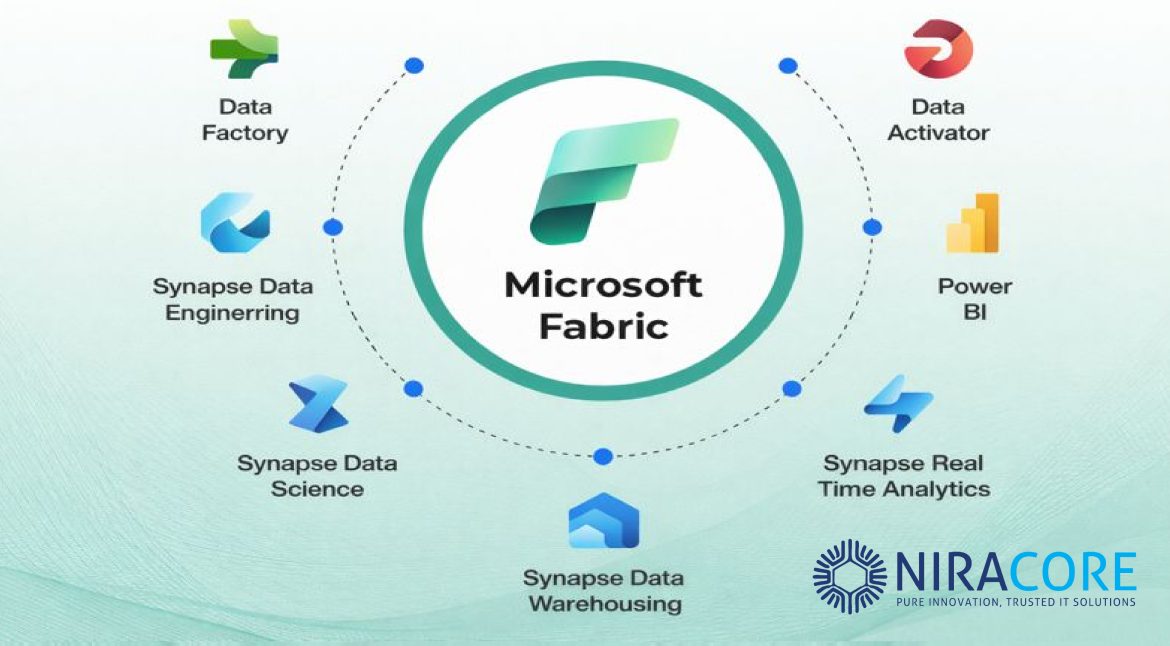
Microsoft Fabric changes this by bringing data integration, data engineering, data warehousing, data science, real-time analytics, and business intelligence together in one unified Software-as-a-Service (SaaS) platform.
Instead of managing multiple technologies separately, businesses can centralize their entire analytics ecosystem on a single platform powered by OneLake, Microsoft’s unified data lake. This enables teams to build scalable analytics solutions, reduce infrastructure complexity, improve collaboration, and generate AI-powered insights faster.
At Niracore, we help organizations unlock the full potential of Microsoft Fabric through consulting, implementation, migration, Power BI modernization, data engineering, AI analytics, governance, and managed support services. Whether you’re modernizing legacy BI systems or building an enterprise-wide analytics platform from scratch, our experts deliver secure, scalable, and future-ready Microsoft Fabric solutions tailored to your business goals.
Core Components of Microsoft Fabric
Power BI: Where Data Finally Becomes Useful
Power BI doesn’t need much introduction. It’s already the go-to BI tool for many organizations, and Fabric builds directly around it. The biggest advantage here is proximityPower BI lives inside the same ecosystem as your data engineering and storage layers.
For business users, this means faster access to trusted data without jumping through hoops. For technical teams, it reduces the friction between data preparation and reporting. Dashboards refresh faster, governance is cleaner, and everyone works off the same version of the truth.
Data Factory: Moving Data Without the Headache
At its core, Data Factory handles one of the least glamorous but most critical jobs in analyticsdata movement. Whether data is coming from on-prem databases, SaaS tools, cloud storage, or APIs, Data Factory pipelines handle ingestion and orchestration.
What makes it more practical inside Fabric is how tightly it integrates with downstream processing. Instead of building pipelines in isolation, teams can design ingestion with a clear line of sight into how the data will be transformed and consumed later.
Synapse Data Engineering: Building the Data Backbone
This is where serious data work happens. Synapse Data Engineering focuses on building and maintaining the systems that store and process large volumes of data reliably.
In real-world projects, this typically means creating a lakehouse a central repository that stores both raw and processed data. Apache Spark is used to clean, enrich, and transform data so it’s ready for analytics. Because Fabric ties Spark jobs directly to Data Factory, scheduling and orchestration feel far more seamless than traditional setups.
For engineering teams, this reduces operational overhead. For businesses, it means fresher data and fewer pipeline failures.
Synapse Data Science: Turning Data into Predictions
Once clean, reliable data is available, data science teams can get to work. Fabric’s data science capabilities support exploratory analysis, experimentation, and machine learning model development.
This isn’t just about building models for the sake of it. In practice, teams use these tools to forecast demand, predict churn, identify anomalies, or recommend next-best actions. The real benefit is that models are built close to the data, reducing complexity and speeding up iteration.
Synapse Data Warehouse: Enterprise-Scale Analytics
For organizations that still rely heavily on structured reporting and SQL-based analytics, Synapse Data Warehouse provides a familiar yet powerful environment.
It’s designed to scale from gigabytes to petabytes without forcing teams to rethink their existing analytics patterns. Whether data originates from internal systems or external applications, it can be consolidated and queried efficiently. This makes it especially valuable for finance, operations, and compliance-heavy use cases.
Synapse Real-Time Analytics: Insights as Events Happen
Some decisions can’t wait for nightly batch jobs. Real-time analytics in Fabric allows organizations to ingest and analyze streaming data sensor readings, application logs, user activity, or transactional events as they occur.
In practical terms, this enables use cases like live monitoring, operational alerts, and near-real-time dashboards. The ability to go from ingestion to visualization quickly is what makes this component stand out.
Why Organizations Are Considering Microsoft Fabric
1) One Platform Instead of Many
The biggest appeal of Fabric is consolidation. Instead of managing multiple tools with separate
security models, billing, and integrations, teams get a single, connected platform. This simplifies
governance and reduces integration pain something most enterprises underestimate until it’s gone
2) Built to Scale
Fabric is designed to grow with your data. Whether you’re a mid-sized company just starting with
analytics or a large enterprise processing massive dataset, the platform scales without forcing
architectural redesigns.
3) Security Comes Built-In
Security isn’t an afterthought. Encryption, role-based access control, and auditing are baked into the
platform, making it easier to meet compliance and governance requirements without layering on
extra tools.
Challenges You Should Be Aware Of
1) Cost Can Add Up
Fabric isn’t the cheapest option especially for smaller organizations. Because it bundles multiple
Azure services, costs can be higher than selecting individual components à la carte. It makes the
most sense when you genuinely need an end-to-end analytics stack.
2) There’s a Learning Curve
For teams new to cloud analytics or Microsoft’s ecosystem, Fabric can feel overwhelming at first. The
breadth of features is a strength, but it also introduces complexity during setup and adoption.
3) Microsoft Ecosystem Commitment
Using Fabric means leaning deeper into Microsoft’s ecosystem. For many organizations, this is a
benefit. For others, it raises concerns about long-term flexibility.
Why Choose Niracore for Microsoft Fabric Services?
At Niracore, we specialize in delivering enterprise-grade Microsoft Fabric solutions that help organizations modernize their analytics ecosystem. Our team combines expertise in Microsoft Fabric, Power BI, Azure Data Services, AI, and Data Engineering to build scalable, secure, and high-performance analytics platforms tailored to your business needs.
Whether you’re planning a new implementation, migrating from legacy systems, or optimizing your existing analytics environment, we help you maximize the value of your Microsoft investment with a strategic, outcome-driven approach.
Subscription, Pricing, and Capacity Planning
Microsoft Fabric uses a capacity-based pricing model. Instead of paying separately for each service, you purchase Capacity Units (CUs) that determine how much compute power is available.
You can choose between pay-as-you-go options or reserved capacity, with longer commitments offering cost savings. The right choice depends on workload predictability, performance needs, and budget.
For teams unsure where to start, Microsoft provides capacity planning tools to estimate requirements before committing.
Why Microsoft Fabric Is a Game-Changer
By combining Data Engineering, Data Warehouse, Data Science, Real-Time Intelligence, Power BI, and AI capabilities into a single platform, Microsoft Fabric eliminates the complexity of managing multiple disconnected analytics tools.
Organizations can build an end-to-end data ecosystem that supports everything from data ingestion and transformation to advanced analytics, machine learning, and executive reporting—all while maintaining consistent governance, security, and scalability.
As businesses continue to embrace AI and data-driven decision-making, Microsoft Fabric provides a future-ready foundation for innovation, operational efficiency, and sustainable growth.
FAQs
Q1. What is Microsoft Fabric used for?
Microsoft Fabric is used for data integration, data engineering, real-time analytics, AI & machine learning solutions, and Power BI reporting all in one platform.
Q2. Can Microsoft Fabric replace traditional data warehouses?
Yes, with Microsoft Fabric Migration Services, businesses can modernize or replace legacy data warehouses efficiently.
Q3. Does Microsoft Fabric support real-time analytics?
Absolutely. Real-Time Analytics & Power BI Reporting allow businesses to monitor live data and make instant decisions.
Q4. Is Microsoft Fabric suitable for AI and advanced analytics?
Yes, Fabric supports Data Engineering & Advanced Analytics along with AI & Machine Learning Solutions for predictive and intelligent insights.